• → European Space Agency

      • Space for Europe
      • Space News
      • Space in Images
      • Space in Videos
    • About Us

      • Welcome to ESA
      • DG's News and Views
      • For Member State Delegations
      • Business with ESA
      • ESA Exhibitions
      • ESA Publications
      • Careers at ESA
    • Our Activities

      • Space News
      • Observing the Earth
      • Human Spaceflight
      • Launchers
      • Navigation
      • Space Science
      • Space Engineering
      • Operations
      • Technology
      • Telecommunications & Integrated Applications
    • For Public

    • For Media

      • Media
      • ESA TV
      • Videos for professionals
      • Photos
    • For Educators

    • For Kids

    • ESA

    • Integral

    • ESA Science

    • Integral in brief
    • Integral overview
    • Integral factsheet
    • A truly international mission
    • About Integral
    • The spacecraft
    • The launcher
    • The launch site - Baikonur
    • The journey
    • Integral's mission

      • What's special?
      • Why do we observe gamma rays?
      • Observations: Seeing in the gamma-ray wavelengths
      • The atoms that make us
      • The densest objects in the Universe
      • Giant black holes
      • Gamma-ray bursts (GRBs)
    • Multimedia
    • Image gallery
    • Pre-launch images, Sept 2002
    • Pre-launch images, October 2002
    • Video gallery
    • 3D Flash 'model'
    • Make a model

    ESA > Our Activities > Space Science > Integral

    Integral sees the Galactic centre playing hide and seek

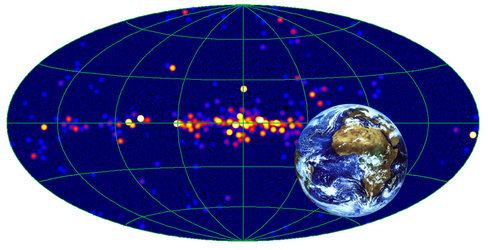
    Integral’s monitoring of the Galactic Centre
    Integral’s monitoring of the Galactic Centre
    18 January 2007

    ESA's gamma ray observatory Integral has caught the centre of our galaxy in a moment of rare quiet. A handful of the most energetic high-energy sources surrounding the black hole at the centre of the Galaxy had all faded into a temporary silence when Integral looked.

    This unusual event is allowing astronomers to probe for even fainter objects and may give them a glimpse of matter disappearing into the massive black hole at the centre of our galaxy.

    The Galactic centre is one of the most dynamic places in our Galaxy. It is thought to be home to a gigantic black hole, called Sagittarius A* (pronounced 'A star'). Since the beginning of the Integral mission, ESA's gamma ray observatory has allowed astronomers to keep watch on this ever-changing environment.

    Integral has discovered many new sources of high-energy radiation near the galactic centre. From February 2005, Integral began to regularly monitor the centre of the Galaxy, and its immediate environment, known as the Galactic bulge.

    Erik Kuulkers of ESA's Integral Science Operations Centre, ESAC, Spain, leads the Galactic bulge monitoring programme. Integral now keeps its high-tech eyes on about 80 high-energy sources in the galactic bulge. "Most of these are X-ray binaries," says Kuulkers.

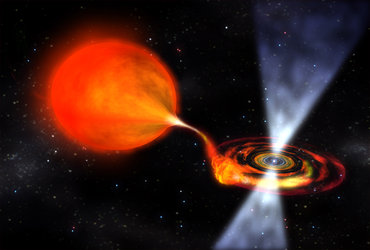
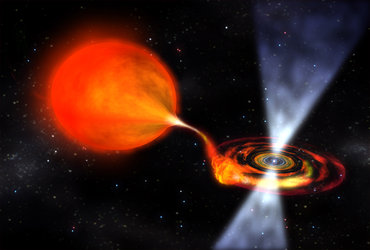
    X-ray binaries are made up of two stars in orbit around one another. One star is a relatively normal star; the other is a collapsed star, such as a white dwarf, neutron star or even a black hole. If the stars are close enough together, the strong gravity of the collapsed star can pull off gaseous material from the normal star. As this gas spirals down around the collapsed star, it is heated to over a million degrees centigrade and this causes it to emit high energy X-rays and gamma rays. The amount of gas falling from one star to the other determines the brightness of the X-ray and gamma-ray emission.


    Integral sees a ‘quiet’ Galactic Centre

    According to the Integral observations in April 2006, the high-energy rays from about ten sources closest to the galactic centre all faded temporarily. Kuulkers excludes the possibility that a mysterious external force is acting on all the objects to drive them into quiescence. "All the sources are variable and it was just by accident or sheer luck that they had turned off during that observation," he says with a smile.

    The fortuitous dimming allows astronomers to set new limits on how faint these X-ray binaries can become. It also allows a number of new investigations to be undertaken with the data.

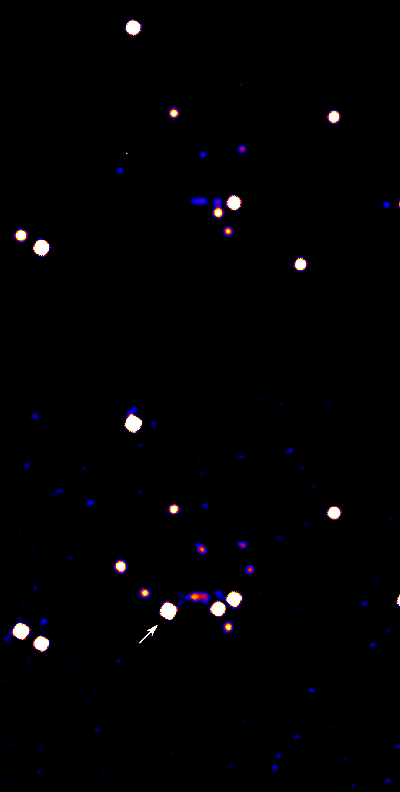
    Integral’s average view of the Galactic Centre

    "When these normally bright sources are faint, we can look for even fainter sources," says Kuulkers. These could be other X-ray binaries or the high-energy radiation from giant molecular clouds interacting with past supernovae. There is also the possibility of detecting the faint high-energy radiation from the massive black hole in our Galaxy's centre.

    Integral's Galactic bulge monitoring programme will continue throughout this year. The data is made available, within a day or two of being collected, to the scientific community via the Internet from a dedicated webpage at the Integral Science Data Centre (IDSC), Geneva, Switzerland. This way, anyone interested in specific sources can watch for interesting changes and trigger follow up observations with other telescopes in good time.

    Notes for editors

    The findings are accepted for publication in the Astronomy & Astrophysics magazine, in the article titled: "The INTEGRAL Galactic bulge monitoring program: the first 1.5 years", by E.Kuulkers et al.

    For more information

    Erik Kuulkers, ESA Integral Science Operations Centre
    Email: erik.kuulkers @ sciops.esa.int

    Christoph Winkler, ESA Integral Project Scientist
    Email: christoph.winkler @ esa.int
    Rate this

    Views

    Share

    • Currently 0 out of 5 Stars.
    • 1
    • 2
    • 3
    • 4
    • 5
    Rating: 0/5 (0 votes cast)

    Thank you for rating!

    You have already rated this page, you can only rate it once!

    Your rating has been changed, thanks for rating!

    82
    Tweet
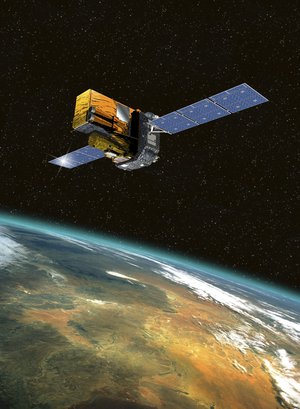
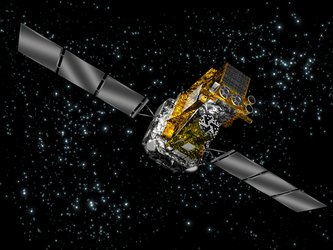
    • Artist's view of Integral
      Artist's view of Integral
      ESA's gamma-ray astronomy mission
    • More about...
      • Integral factsheet
      • Related articles
        • Integral catches a new erupting black hole
          • ESA steps towards a great black hole census
            • Where are the supermassive black holes hiding?
              • Integral sees a GRB out of the corner of its eye
                • Integral catches stellar 'corpses' by the tail
                  • Exceptional manoeuvres enable unique Integral science
                    • Integral identifies supernova rate for Milky Way
                      • Integral: three years of insight into the violent cosmos
                        • Star eats companion
                          • Three satellites needed to bring out ‘shy star’
                            • Integral rolls back history of Milky Way's super-massive black hole
                              • ESA's Integral detects closest cosmic gamma-ray burst
                                • Observations: Seeing in the gamma-ray wavelengths
                                • Related links
                                • Integral Galactic bulge monitoring
                                • Integral Science Data Centre

    Connect with us

    • RSS
    • Youtube
    • Twitter
    • Flickr
    • G+
    • Facebook
    • Livestream
    • Subscribe
    • App Store
    • LATEST ARTICLES
    • · Earth Explorers take centre stage …
    • · The fast winds of Venus are gettin…
    • · ExoMars 2016 set to complete const…
    • · Herschel ends operations as orbiti…
    • · Europe’s largest spaceship reache…
    • FAQ

    • Jobs at ESA

    • Site Map

    • Contacts

    • Terms and conditions