• → European Space Agency

      • Space for Europe
      • Space News
      • Space in Images
      • Space in Videos
    • About Us

      • Welcome to ESA
      • DG's News and Views
      • For Member State Delegations
      • Business with ESA
      • ESA Exhibitions
      • ESA Publications
      • Careers at ESA
    • Our Activities

      • Space News
      • Observing the Earth
      • Human Spaceflight
      • Launchers
      • Navigation
      • Space Science
      • Space Engineering
      • Operations
      • Technology
      • Telecommunications & Integrated Applications
    • For Public

    • For Media

      • Media
      • ESA TV
      • Videos for professionals
      • Photos
    • For Educators

    • For Kids

    • ESA

    • Space Science

    • Our Universe
    • About Space Science
    • ESA's 'Cosmic Vision'
    • Science missions
    • Mission navigator
    • Target groups
    • For Media
    • For Scientists
    • For Kids
    • Multimedia
    • Science images
    • Science videos
    • Animations
    • Downloads
    • Sounds from space
    • Resources
    • Reference section
    • Services
    • FAQs
    • Glossary
    • Help
    • Portal terms of use
    • Comments
    • Follow us
    • RSS feeds
    • ESA Sci on Twitter
    • ESA Space Science Images on Flickr
    • ESA 3D on Flickr

    ESA > Our Activities > Space Science

    Jorge Vago

    ExoMars Project Scientist, ESA-ESTEC, Netherlands

    Subjects: ExoMars mission and science overview, Martian space environment

    What makes ExoMars so special with respect to other past, current and even future missions to Mars?

    ExoMars will carry the most complete suite of instruments dedicated to organic and mineralogical studies ever planned for a Mars mission. With its powerful rover and drill, ExoMars will also be the first mission combining mobility and access to subsurface locations where organic molecules may be well-preserved; thus allowing, for the first time, to investigate Mars’s third dimension: depth. This alone is a guarantee that ExoMars will break new scientific ground.

    What are the major technological challenges the ExoMars mission has to overcome to achieve its objectives?

    The first and most important challenge is to land safely on Mars. To achieve this, ESA is developing a novel landing technology based on a double parachute system, liquid throttled engines and a new type of airbag design.

    Other key milestones will be the successful deployment of the rover onto the martian surface, and the utilisation of the subsurface drill and the sample preparation and distribution system (SPDS) in combination with the instruments.


    What major criteria do you need to follow to select the final landing site?

    The major scientific requirement for ExoMars candidate landing sites is that they show evidence of a past water-rich environment. This evidence must be both morphological (e.g. orbital images of deltas, lakes, or channel systems) and mineralogical (e.g. spectral signatures of minerals that form in water environment and that can preserve organic matter well, like clays, salts, etc.). The site must not contain a lot of dust, as dust is very poor for the preservation of biomarkers.

    The other major requirement is that candidate sites must be safe to land on. There is a large number of engineering requirements that must be satisfied. They include altitude, latitude, terrain slopes, rock size and distribution, etc.

    Finding a safe place to land that has a very high science interest will entail much work over a period spanning about four years.

    How is Mars Express helping in the preparation of ExoMars?

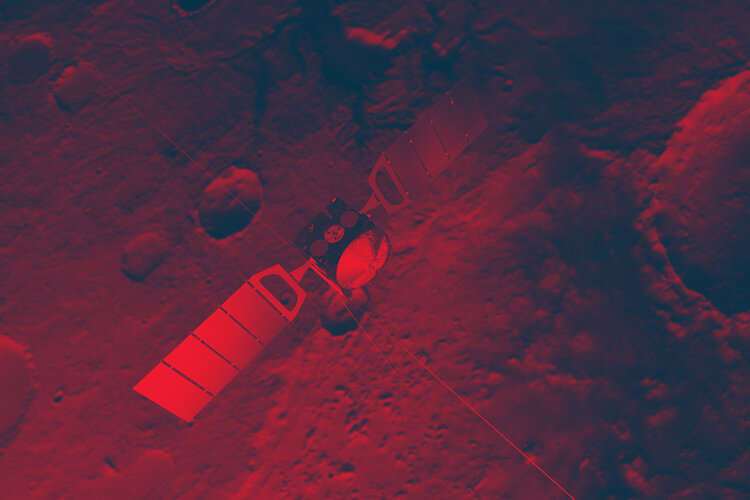
    Mars Express has helped immensely because it is a mission that has changed our understanding of many key processes on Mars. In particular, it has confirmed that Mars was a much more hospitable planet during the first of its 4.6 thousand million-year history. At that time, as life started on Earth, conditions on the red planet allowed water to exist on the surface.

    Mars Express will also help to identify suitable candidate landing sites. Its instruments, particularly the HRSC camera and the OMEGA spectrometer, will be used to study sites in detail. Besides Mars Express, NASA’s MRO will also contribute to the detailed search for top landing locations.
    Last update: 16 November 2007

    Rate this

    Views

    Share

    • Currently 0 out of 5 Stars.
    • 1
    • 2
    • 3
    • 4
    • 5
    Rating: 0/5 (0 votes cast)

    Thank you for rating!

    You have already rated this page, you can only rate it once!

    Your rating has been changed, thanks for rating!

    82
    Tweet
    • Looking at Mars
    • Mars Express highlights
    • Water on Mars
    • Interviews
    • Mars and the search for traces of life
      • Jean-Pierre Bibring
        • Agustin Chicarro
          • François Forget
            • Roberto Orosei
              • John Parnell
                • Jeffrey Plaut
                  • Jorge Vago
                    • Frances Westall
                    • Related articles
                      • Mars Express: First global map of martian ionosphere
                        • Setting stars reveal planetary secrets
                          • Interplanetary networking: ESA’s Mars Express will keep an eye on NASA’s Phoenix
                            • Relays from Mars demonstrate international interplanetary networking
                              • The origin of perennial water-ice at the South Pole of Mars

    Connect with us

    • RSS
    • Youtube
    • Twitter
    • Flickr
    • G+
    • Facebook
    • Livestream
    • Subscribe
    • App Store
    • ESA Science Twitter

    Follow ESA science

    • LATEST ARTICLES
    • · The fast winds of Venus are gettin…
    • · ExoMars 2016 set to complete const…
    • · Herschel ends operations as orbiti…
    • · Europe’s largest spaceship reache…
    • · ATV ready to nose up to Station
    • FAQ

    • Jobs at ESA

    • Site Map

    • Contacts

    • Terms and conditions