• → European Space Agency

      • Space for Europe
      • Space News
      • Space in Images
      • Space in Videos
    • About Us

      • Welcome to ESA
      • DG's News and Views
      • For Member State Delegations
      • Business with ESA
      • ESA Exhibitions
      • ESA Publications
      • Careers at ESA
    • Our Activities

      • Space News
      • Observing the Earth
      • Human Spaceflight
      • Launchers
      • Navigation
      • Space Science
      • Space Engineering
      • Operations
      • Technology
      • Telecommunications & Integrated Applications
    • For Public

    • For Media

    • For Educators

    • For Kids

    • ESA

    • ESA Science

    • Mars Express

    • Europe goes to Mars

      • Europe reclaims a stake in Mars exploration
      • Space age transforms our knowledge about Mars
    • About Mars Express

      • Mars Express mission facts
      • Mars Express instruments
      • The mission
      • The spacecraft
      • The launcher
    • About Mars

      • Geography of Mars
      • Water on early Mars?
      • Signatures of life
      • Facts about Mars
    • Meet the team

      • International collaboration
      • Project Manager
      • Project Scientist
      • Mars Lead Scientist
      • Principal Investigators
      • Operations
      • Industry
    • Multimedia
    • VideoTalk
    • Mars Express images
    • Mars Express videos
    • HRSC videos
    • Animation in 11 languages
    • Download wallpapers
    • Download screensavers
    • 3D Flash 'model'
    • Make a model
    • Services
    • Comments

    ESA > Our Activities > Space Science > Mars Express

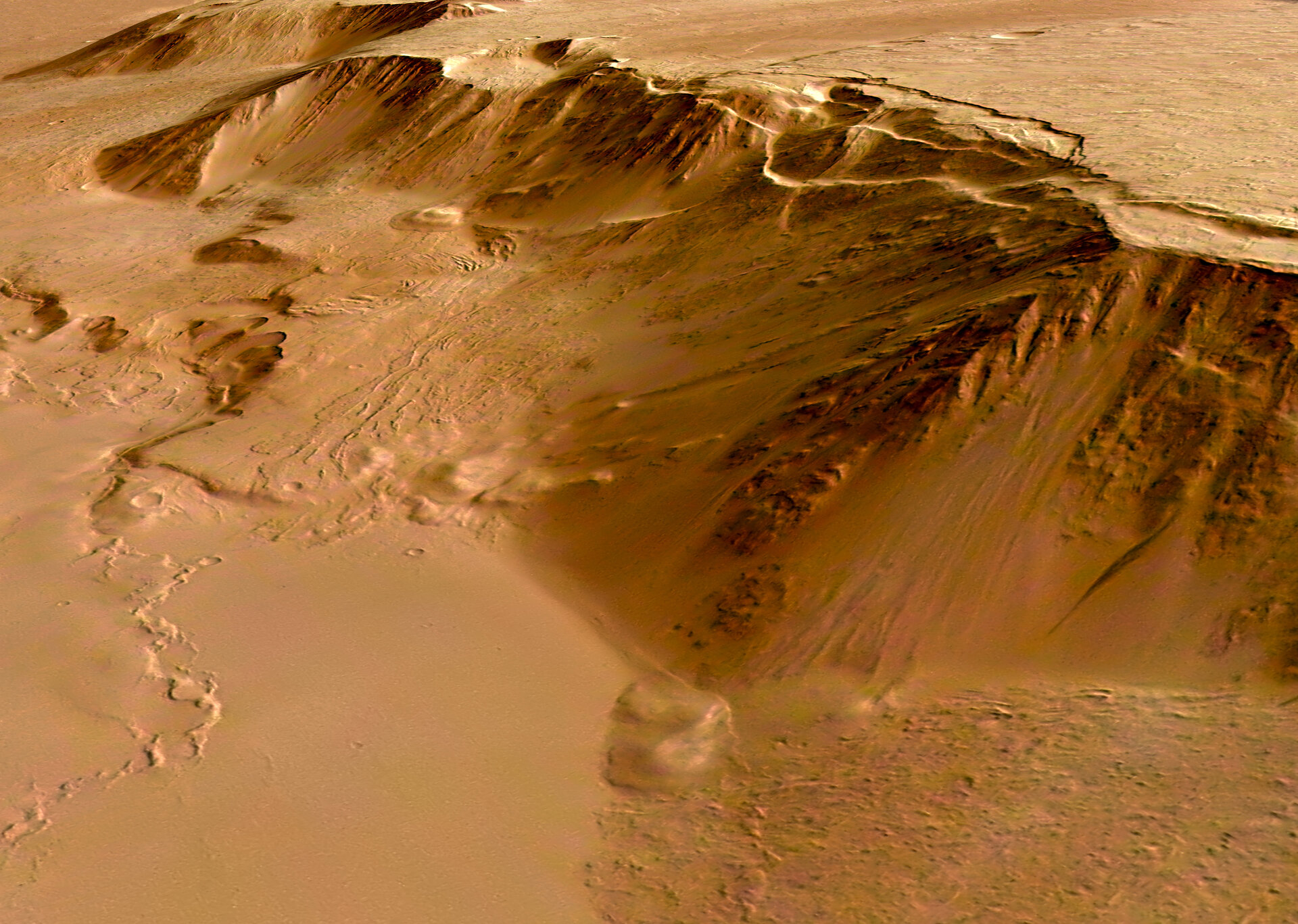
    Perspective view of the eastern scarp of Olympus Mons, looking south-west

    Eastern scarp of Olympus Mons

    3 March 2006

    These images, taken by the High Resolution Stereo Camera (HRSC) on board ESA’s Mars Express spacecraft, show the eastern scarp of the Olympus Mons volcano on Mars.
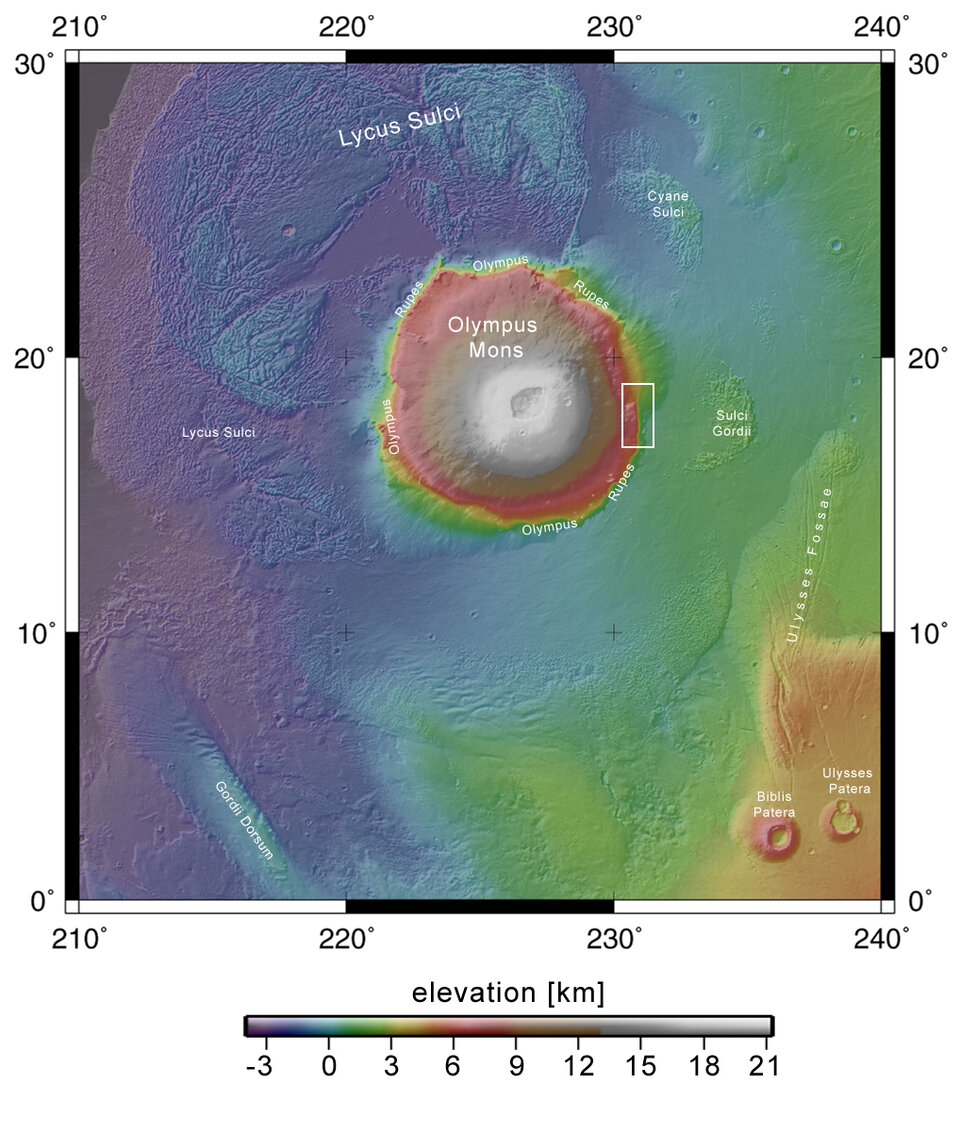
    Map showing location of scarp in context

    The HRSC obtained these images during orbit 1089 with a ground resolution of approximately 11 metres per pixel. The image is centred at 17.5° North and 230.5° East. The scarp is up to six kilometres high in places.

    The surface of the summit plateau’s eastern flank shows lava flows that have are several kilometres long and a few hundred metres wide.

    Age determinations show that they are up to 200 million years old, in some places even older, indicating episodic geological activity.
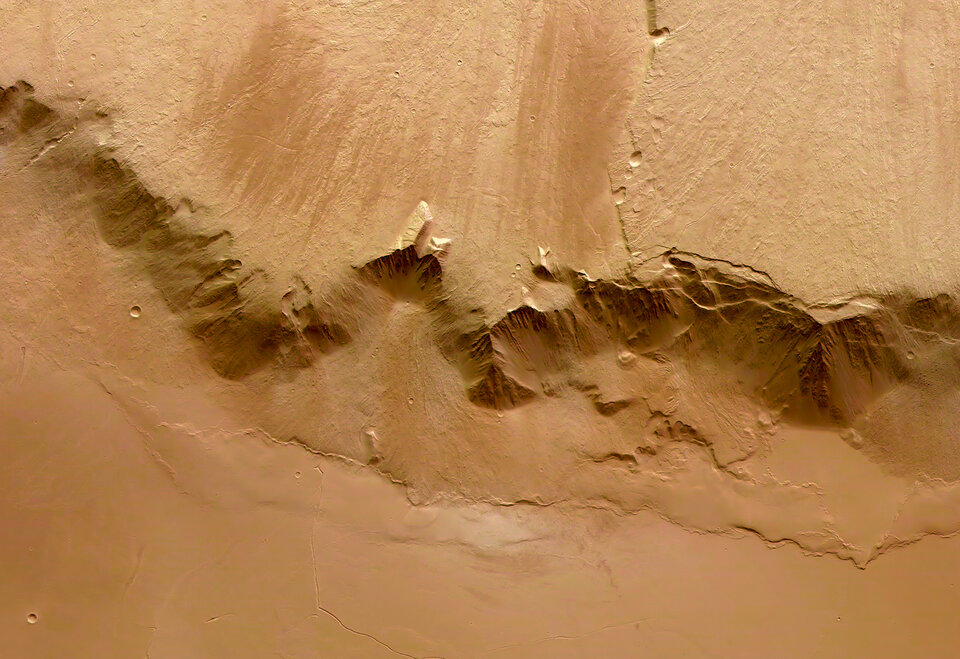

    Colour view of eastern scarp of Olympus Mons

    The lowland plains, seen here in the eastern part of the image (bottom), typically have a smooth surface.

    Several channel-like features are visible which form a broad network composed of intersecting and ‘anastomosing’* channels that are several kilometres long and up to 40 metres deep. (*Anastomising means branching extensively and crossing over one another, like veins on the back of your hand.)
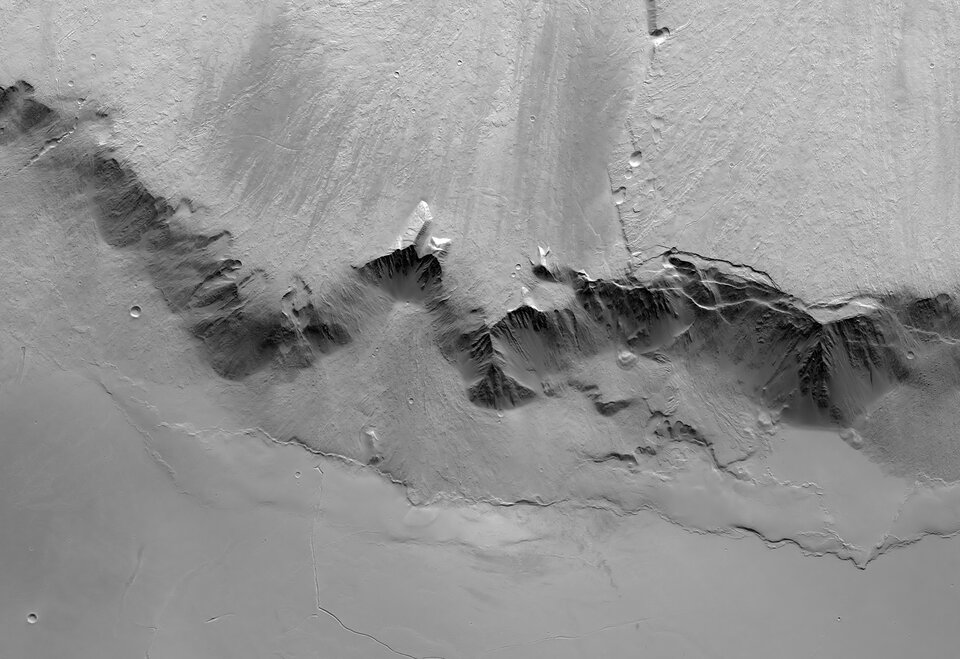
    Black and white view of eastern scarp of Olympus Mons

    Several incisions suggest a tectonic control, others show streamlined islands and terraced walls suggesting outflow activity.

    Age determinations show that the network-bearing area was geologically active as recent as 30 million years ago.

    Between the edge of the lowland plains and the bottom of the volcano slope, there are ‘wrinkle ridges’ which are interpreted as the result of compressional deformation. In some places, wrinkle ridges border the arch-like terraces at the foot of the volcano slope.
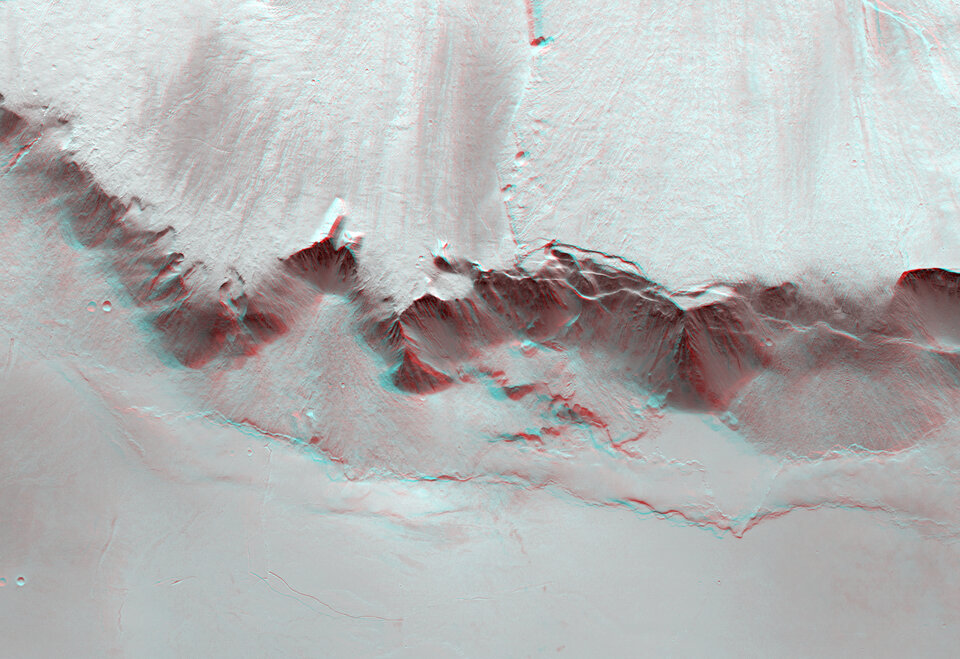
    3D view of eastern scarp of Olympus Mons

    The colour scenes have been derived from the three HRSC-colour channels and the nadir channel.

    The perspective views have been calculated from the digital terrain model derived from the stereo channels.

    Perspective view of eastern scarp of Olympus Mons, looking west

    The 3D anaglyph image was calculated from the nadir and one stereo channel. Image resolution has been decreased for use on the internet.

    For more information on Mars Express HRSC images, you might like to read our updated 'Frequently Asked Questions'.

    Rate this

    Views

    Share

    • Currently 5 out of 5 Stars.
    • 1
    • 2
    • 3
    • 4
    • 5
    Rating: 5/5 (1 votes cast)

    Thank you for rating!

    You have already rated this page, you can only rate it once!

    Your rating has been changed, thanks for rating!

    297
    Tweet
    • Mars Express image browser
    • Recent images
      • Lava tubes on Pavonis Mons
        • Extensional tectonics in Tempe Terra
          • Nanedi Valles system on Mars
            • 'Happy face' crater on Mars
              • The Libya Montes valley on Mars
                • 'Hourglass'-shaped crater - new video and perspectives
                  • Eastern scarp of Olympus Mons
                    • Ausonia Mensa remnant massif
                      • Pits and tectonic grabens in Phlegethon Catena
                        • Claritas Fossae region of Mars
                          • Sulphate deposits in Juventae Chasma
                            • ‘Butterfly’ impact crater in Hesperia Planum
                              • Fly over the Chasma Boreale at Martian north pole
                                • The Biblis Patera volcano
                                • High Resolution Stereo Camera
                                  • Behind the lens...

    Connect with us

    • RSS
    • Youtube
    • Twitter
    • Flickr
    • G+
    • Facebook
    • Livestream
    • Subscribe
    • App Store
    • LATEST ARTICLES
    • · Proba-V opens its eyes
    • · First new Galileo satellite arrive…
    • · Next destination: space
    • · Leak repaired on International Spa…
    • · After Chelyabinsk: European expert…
    • FAQ

    • Jobs at ESA

    • Site Map

    • Contacts

    • Terms and conditions