• → European Space Agency

      • Space for Europe
      • Space News
      • Space in Images
      • Space in Videos
    • About Us

      • Welcome to ESA
      • DG's News and Views
      • For Member State Delegations
      • Business with ESA
      • ESA Exhibitions
      • ESA Publications
      • Careers at ESA
    • Our Activities

      • Space News
      • Observing the Earth
      • Human Spaceflight
      • Launchers
      • Navigation
      • Space Science
      • Space Engineering
      • Operations
      • Technology
      • Telecommunications & Integrated Applications
    • For Public

    • For Media

      • Media
      • ESA TV
      • Videos for professionals
      • Photos
    • For Educators

    • For Kids

    • ESA

    • ESA Science

    • Mars Express

    • Europe goes to Mars

      • Europe reclaims a stake in Mars exploration
      • Space age transforms our knowledge about Mars
    • About Mars Express

      • Mars Express mission facts
      • Mars Express instruments
      • The mission
      • The spacecraft
      • The launcher
    • About Mars

      • Geography of Mars
      • Water on early Mars?
      • Signatures of life
      • Facts about Mars
    • Meet the team

      • International collaboration
      • Project Manager
      • Project Scientist
      • Mars Lead Scientist
      • Principal Investigators
      • Operations
      • Industry
    • Multimedia
    • VideoTalk
    • Mars Express images
    • Mars Express videos
    • HRSC videos
    • Animation in 11 languages
    • Download wallpapers
    • Download screensavers
    • 3D Flash 'model'
    • Make a model
    • Services
    • Comments

    ESA > Our Activities > Space Science > Mars Express

    Pavonis Mons

    Lava tubes on Pavonis Mons

    23 May 2006

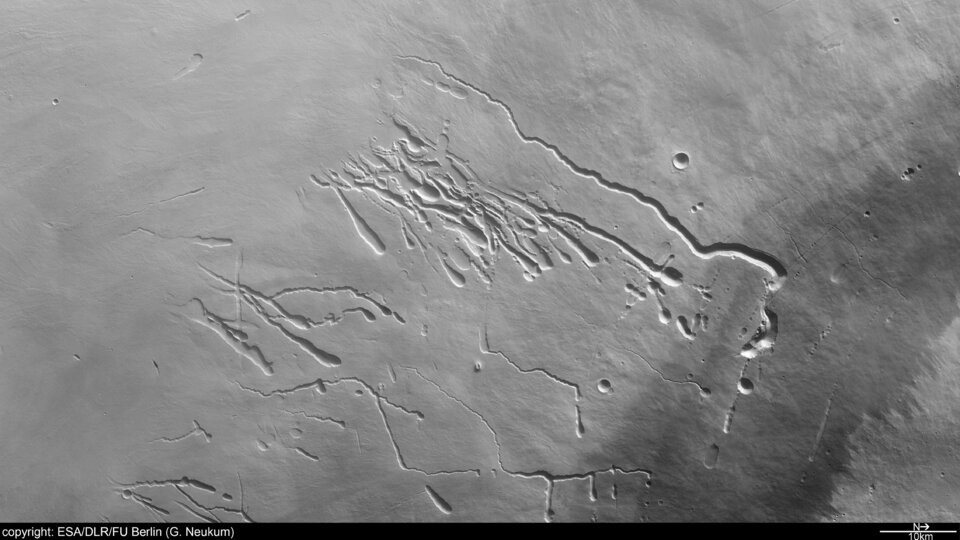
    These images, taken by the High Resolution Stereo Camera (HRSC) on board ESA's Mars Express, show Pavonis Mons, the central volcano of the three 'shield' volcanoes that comprise Tharsis Montes.

    Context map, Pavonis Mons
    Map showing Pavonis Mons in context

    ESA's Mars Express spacecraft obtained these images using the HRSC during orbit 902 with a ground resolution of approximately 14.3 metres per pixel. The images were acquired in the region of Pavonis Mons, at approximately 0.6° South and 246.4° East.

    The context map is centred on Pavonis Mons, one of the three volcanoes called Tharsis Montes (the others being Arsia and Ascreus Montes, aligned with Pavonis in a line nearly 1500 km long).

    Pavonis Mons
    Pavonis Mons in Tharsis Montes

    Pavonis Mons, rising roughly 12 km above the surrounding plains, is the central volcano of the three 'shield' volcanoes that comprise Tharsis Montes. Gently sloping shield volcanoes are shaped like a flattened dome and are built almost exclusively of lava flows.

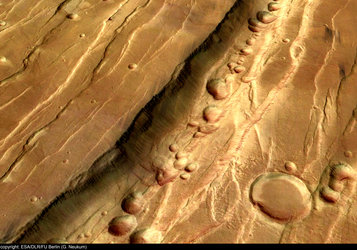
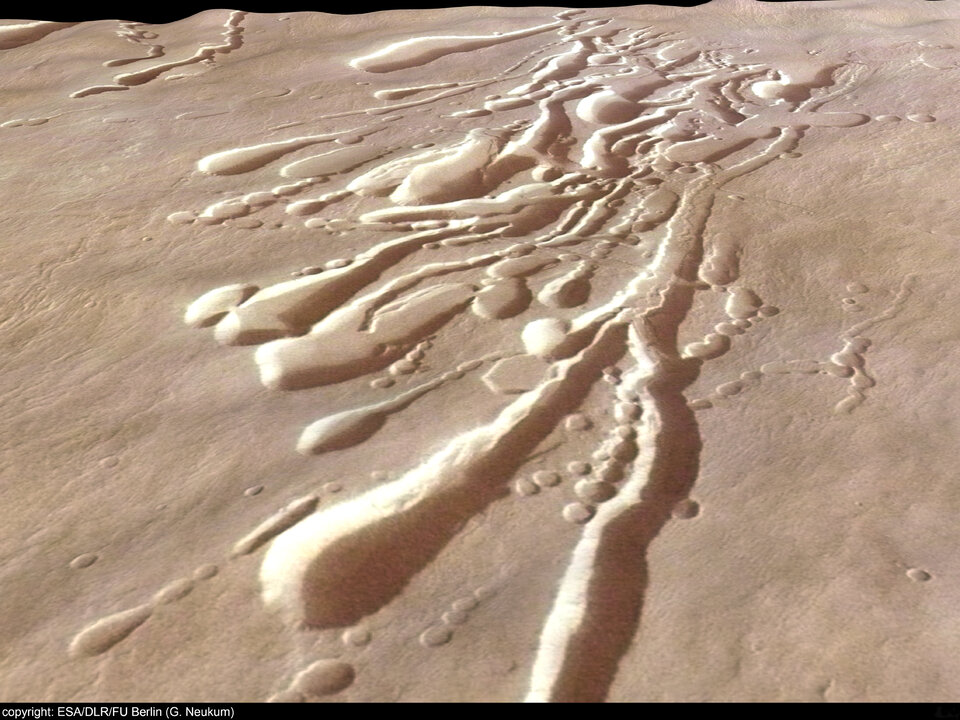
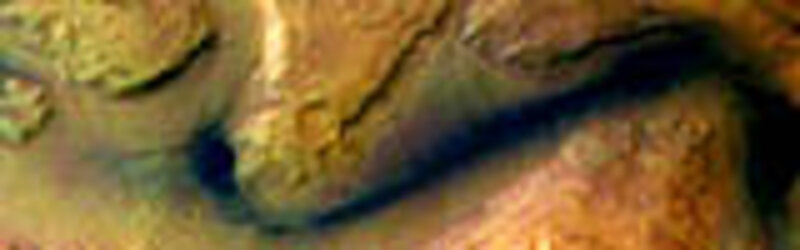
    The dramatic features visible in the colour image are located on the south-west flank of Pavonis Mons. Researchers believe these are lava tubes, channels originally formed by hot, flowing lava that forms a crust as the surface cools. Lava continues to flow beneath this hardened surface, but when the lava production ends and the tunnels empty, the surface collapses, forming elongated depressions. Similar tubes are well known on Earth and the Moon.
    Lava tubes on Pavonis Mons, in perspective

    The long, continuous lava tube in the northwest of the colour image extends over 59 km and ranges from approximately 1.9 km to less than 280 m wide.

    Pit chains, strings of circular depressions thought to form as the result of collapse of the surface, are also visible within the colour image. In the northeast, there is a clear distinction between the brighter terrain at higher elevations and darker material located down slope. In the southwest, the lava tubes appear to be covered by subsequent lava flows.
    Pavonis Mons, 3-D anaglyph
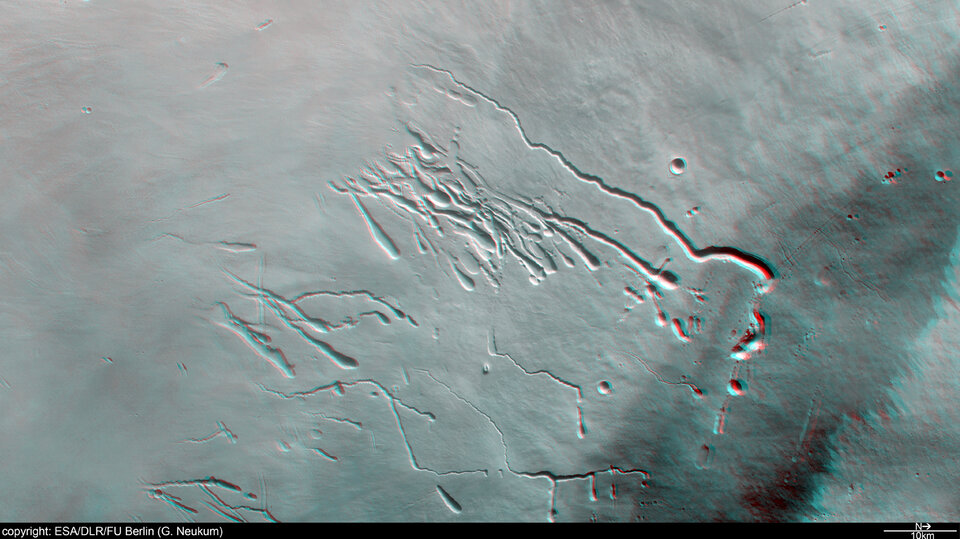
    3D anaglyph of Pavonis Mons in Tharsis Montes

    By studying Martian volcanoes, scientists can obtain information regarding this intriguing planet. For example, the gradual flank slopes and the flattened, dome-like appearance of Pavonis Mons suggest that low-viscosity lava formed this volcano.

    The colour scene was derived from the three HRSC-colour channels and the nadir channel. The 3D anaglyph image was calculated from the nadir and one stereo channel. Image resolution has been decreased for use on the internet.

    For more information on Mars Express HRSC images, please read our updated FAQ (frequently asked questions).
    Rate this

    Views

    Share

    • Currently 5 out of 5 Stars.
    • 1
    • 2
    • 3
    • 4
    • 5
    Rating: 5/5 (1 votes cast)

    Thank you for rating!

    You have already rated this page, you can only rate it once!

    Your rating has been changed, thanks for rating!

    483
    Tweet
    • Mars Express image browser
    • Recent images
      • Lava tubes on Pavonis Mons
        • Extensional tectonics in Tempe Terra
          • Nanedi Valles system on Mars
            • 'Happy face' crater on Mars
              • The Libya Montes valley on Mars
                • 'Hourglass'-shaped crater - new video and perspectives
                  • Eastern scarp of Olympus Mons
                    • Ausonia Mensa remnant massif
                      • Pits and tectonic grabens in Phlegethon Catena
                        • Claritas Fossae region of Mars
                          • Sulphate deposits in Juventae Chasma
                            • ‘Butterfly’ impact crater in Hesperia Planum
                              • Fly over the Chasma Boreale at Martian north pole
                                • The Biblis Patera volcano
                                • High Resolution Stereo Camera
                                  • Behind the lens...

    Connect with us

    • RSS
    • Youtube
    • Twitter
    • Flickr
    • G+
    • Facebook
    • Livestream
    • Subscribe
    • App Store
    • LATEST ARTICLES
    • · The fast winds of Venus are gettin…
    • · ExoMars 2016 set to complete const…
    • · Herschel ends operations as orbiti…
    • · Europe’s largest spaceship reache…
    • · ATV ready to nose up to Station
    • FAQ

    • Jobs at ESA

    • Site Map

    • Contacts

    • Terms and conditions