• → European Space Agency

      • Space for Europe
      • Space News
      • Space in Images
      • Space in Videos
    • About Us

      • Welcome to ESA
      • DG's News and Views
      • For Member State Delegations
      • Business with ESA
      • ESA Exhibitions
      • ESA Publications
      • Careers at ESA
    • Our Activities

      • Space News
      • Observing the Earth
      • Human Spaceflight
      • Launchers
      • Navigation
      • Space Science
      • Space Engineering
      • Operations
      • Technology
      • Telecommunications & Integrated Applications
    • For Public

    • For Media

    • For Educators

    • For Kids

    • ESA

    • ESA Science

    • Mars Express

    • Europe goes to Mars

      • Europe reclaims a stake in Mars exploration
      • Space age transforms our knowledge about Mars
    • About Mars Express

      • Mars Express mission facts
      • Mars Express instruments
      • The mission
      • The spacecraft
      • The launcher
    • About Mars

      • Geography of Mars
      • Water on early Mars?
      • Signatures of life
      • Facts about Mars
    • Meet the team

      • International collaboration
      • Project Manager
      • Project Scientist
      • Mars Lead Scientist
      • Principal Investigators
      • Operations
      • Industry
    • Multimedia
    • VideoTalk
    • Mars Express images
    • Mars Express videos
    • HRSC videos
    • Animation in 11 languages
    • Download wallpapers
    • Download screensavers
    • 3D Flash 'model'
    • Make a model
    • Services
    • Comments

    ESA > Our Activities > Space Science > Mars Express

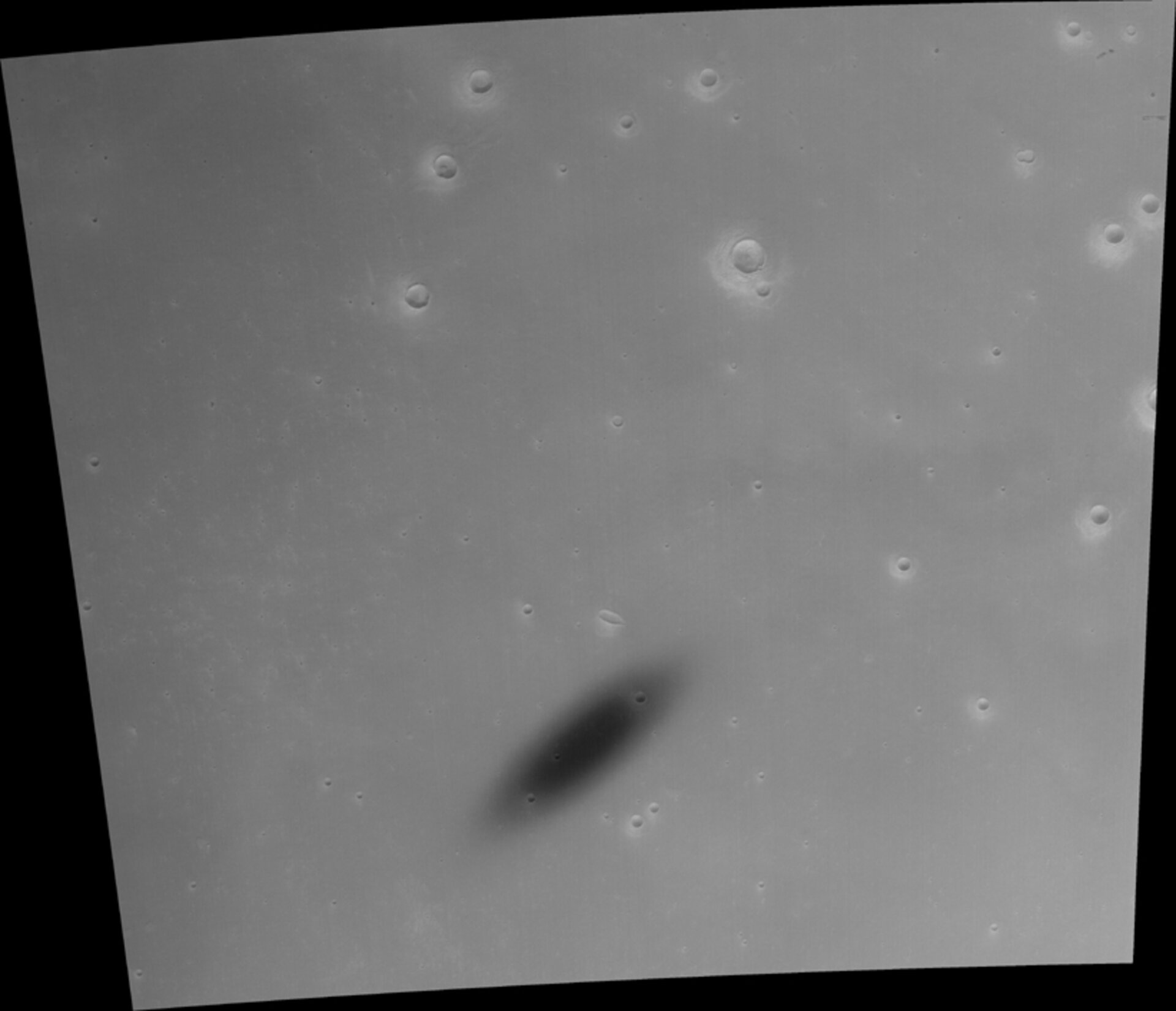
    Black and white HRSC view of Phobos's shadow

    Light and shadow on the surface of Mars

    17 February 2006

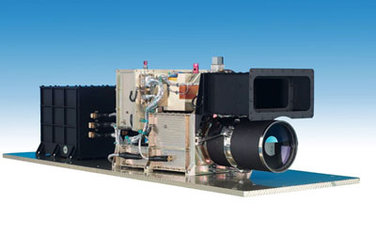
    These images, taken by the High Resolution Stereo Camera (HRSC) on board ESA’s Mars Express spacecraft, show the fast-moving shadow of the moon Phobos as it moved across the Martian surface.

    The HRSC obtained these unique images during orbit 2345 on 10 November 2005. These observations would not have been possible without the close co-operation between the camera team at the Institute of Planetary Research at DLR and the ESA teams, in particular the mission engineers at ESA's European Space Operations Centre (ESOC) in Darmstadt, Germany.
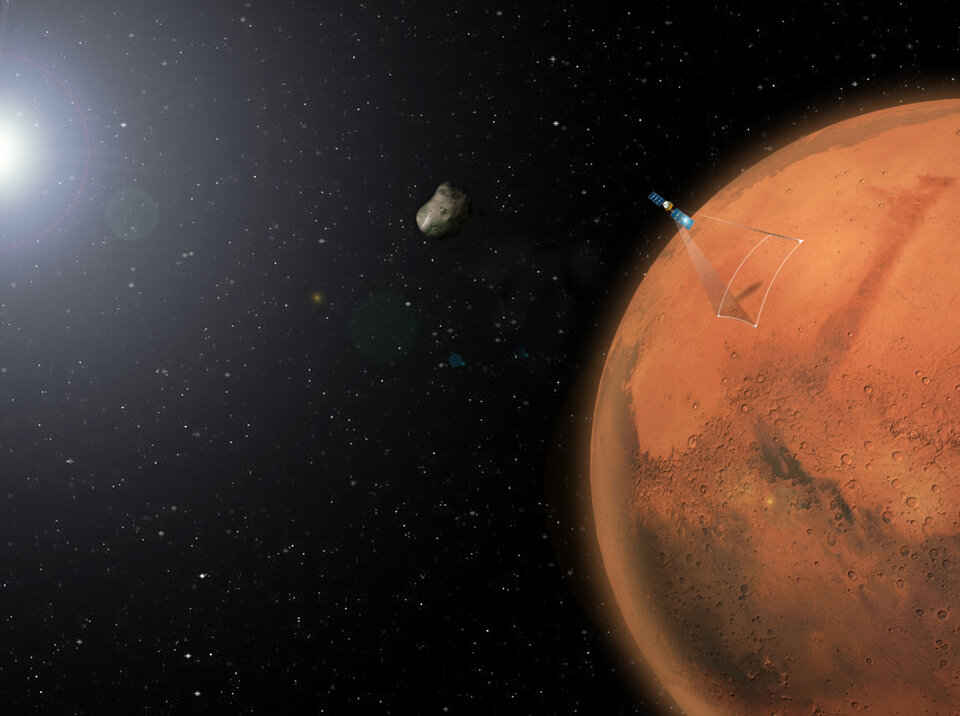
    Artist's impression of Mars Express and Phobos

    They confirm the model of the moon’s orbit around Mars, as it was determined earlier in 2004 also on the basis of HRSC images. They also show that with accurate planning even moving objects can be captured exactly at their predicted position.

    The basis for such observations is the accurate knowledge of the spacecraft position in its orbit as well as of the targeted location on Mars to within a few hundred metres.

    Phobos is the larger of the two Martian moons, 27 kilometres by 22 kilometres in size, and travels around Mars in an almost circular orbit at an altitude of about 6000 kilometres. Phobos takes slightly more than 7.5 hours to complete a full revolution around the planet.
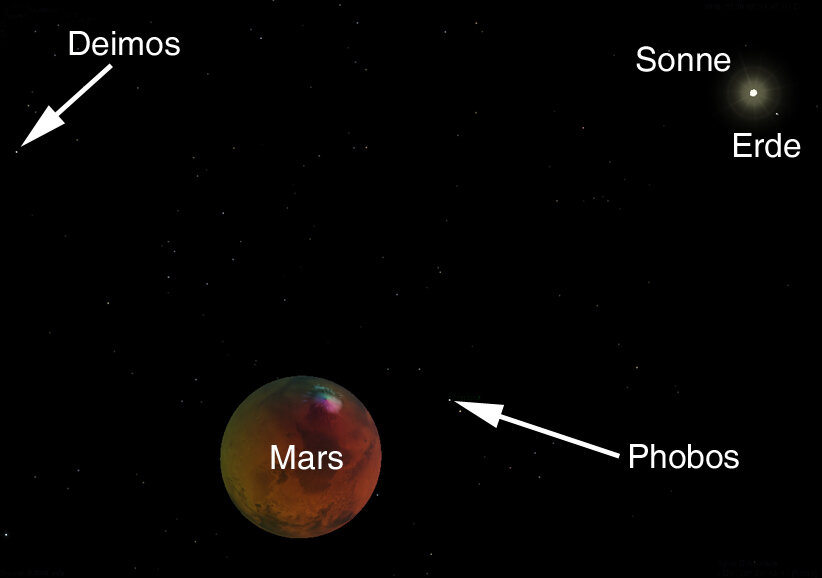

    An animation of the shadow of Phobos on the surface of Mars

    When it is between the Sun and Mars, Phobos casts a small and diffuse shadow onto the Martian surface. To an observer on Mars, this would appear as a very quick eclipse of the Sun. This is similar to an eclipse on Earth, when the Moon covers the solar disk but much slower.

    The shadow of Phobos has an elliptical shape on the Martian surface, because the shadow’s cone hits the surface at an oblique angle. This shadow appears to be distorted even more because of the imaging technique of the HRSC.

    The shadow moves across the surface with a speed of roughly 7200 kilometres per hour from west to east. The spacecraft travels with a higher speed of about 12 600 kilometres per hour on its almost polar orbit from south to north.
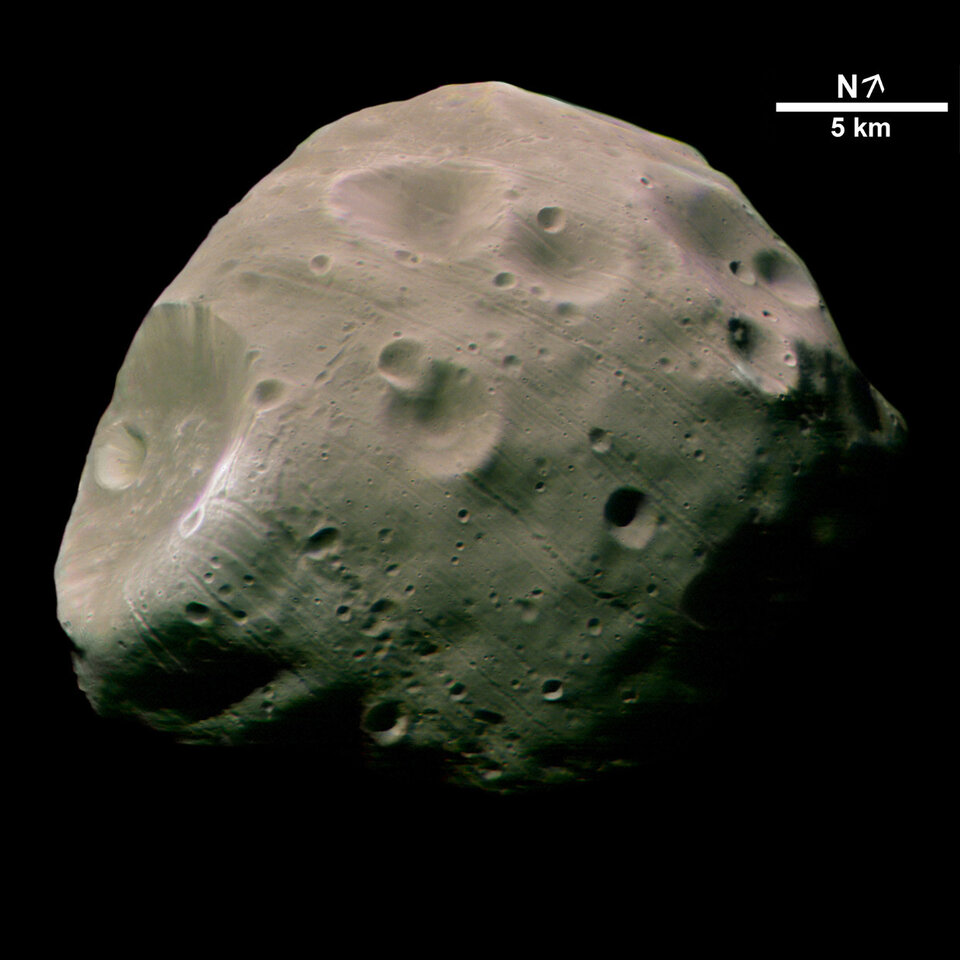
    Phobos in colour, close-up

    Since HRSC scans the surface synchronised with the flight velocity of Mars Express, it takes some time to cover the shadow in its full dimension. Within this short time, however, the moon moves on, and therefore the shape of its shadow is ‘smeared’ in the HRSC image.

    Another phenomenon, that the shadow is darker at its centre than the edges, can be explained by again imagining the observer on Mars. With its small size, Phobos would only cover some 20% of the solar disk.

    Even if the observer stood in the centre of the shadow, they would still be illuminated by the uncovered part of the Sun’s disk, in a partial solar eclipse instead of a total eclipse.

    Members of the HRSC Science Team recalculated the orbit of Phobos on the basis of images taken in 2004. With the help of the improved orbit determination – the moon has advanced about 12 kilometres with respect to its previously predicted position along its orbit – it was possible to calculate those precise times when the shadow observations could be made. In turn, it was possible to verify the accuracy of the improved orbit determination by the shadow’s position in the new images.

    For more information on Mars Express HRSC images, you might like to read our updated 'Frequently Asked Questions'.
    Rate this

    Views

    Share

    • Currently 0 out of 5 Stars.
    • 1
    • 2
    • 3
    • 4
    • 5
    Rating: 0/5 (0 votes cast)

    Thank you for rating!

    You have already rated this page, you can only rate it once!

    Your rating has been changed, thanks for rating!

    103
    Tweet
    • Mars Express image browser
    • Recent images
      • Lava tubes on Pavonis Mons
        • Extensional tectonics in Tempe Terra
          • Nanedi Valles system on Mars
            • 'Happy face' crater on Mars
              • The Libya Montes valley on Mars
                • 'Hourglass'-shaped crater - new video and perspectives
                  • Eastern scarp of Olympus Mons
                    • Ausonia Mensa remnant massif
                      • Pits and tectonic grabens in Phlegethon Catena
                        • Claritas Fossae region of Mars
                          • Sulphate deposits in Juventae Chasma
                            • ‘Butterfly’ impact crater in Hesperia Planum
                              • Fly over the Chasma Boreale at Martian north pole
                                • The Biblis Patera volcano
                                • High Resolution Stereo Camera
                                  • Behind the lens...

    Connect with us

    • RSS
    • Youtube
    • Twitter
    • Flickr
    • G+
    • Facebook
    • Livestream
    • Subscribe
    • App Store
    • LATEST ARTICLES
    • · ESA astronaut Timothy Peake set fo…
    • · Space drives e-mobility
    • · Proba-V opens its eyes
    • · First new Galileo satellite arrive…
    • · Next destination: space
    • FAQ

    • Jobs at ESA

    • Site Map

    • Contacts

    • Terms and conditions