ESAIntegralESA Science
   
Integral in brief
Integral overviewIntegral factsheetA truly international mission
About Integral
The spacecraftThe launcherThe launch site - BaikonurThe journey
Integral's mission
Multimedia
Image galleryPre-launch images, Sept 2002Pre-launch images, October 2002Video gallery3D Flash 'model'Make a model


News
 
printer friendly page
Integral disproves dark matter origin for mystery radiation
 
The galactic centre
 
22 July 2009
A team of researchers working with data from ESA’s Integral gamma-ray observatory has disproved theories that some form of dark matter explains mysterious radiation in the Milky Way.
 
That this radiation exists has been known since the 1970s, and several theories have been proposed to explain it. Integral’s unprecedented spectral and spatial resolution showed that it strongly peaks towards the centre of the Galaxy, with an asymmetry along the Galactic disc.

Several researchers have invoked a variety of dark matter to explain Integral’s observations. Dark matter is thought to exist throughout the Universe – undetectable matter that differs from the normal material that makes up stars, planets and us. It is also believed to be present within and around the Milky Way, in the form of a halo.  
 
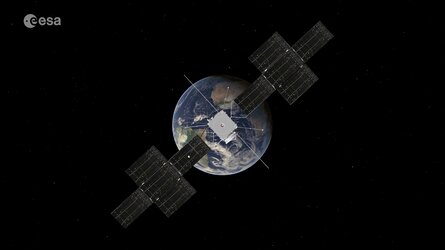
Integral, artist’s impression
The recent study has found that the ‘positrons’ fuelling the radiation are not produced from dark matter but from an entirely different, and much less mysterious, source: massive stars explode and leave behind radioactive elements that decay into lighter particles, including positrons, the antimatter counterparts of electrons.

The reasoning behind the original hypothesis was that positrons, being electrically charged, would be affected by magnetic fields and thus would not be able to travel far. As the radiation was observed in places that did not match the known distribution of stars, dark matter was invoked as an alternative for the origin of the positrons.

But the recent finding by a team of astronomers led by Richard Lingenfelter at the University of California at San Diego, proves otherwise. The astronomers show that the positrons formed by radioactive decay of elements left behind after explosions of massive stars are, in fact, able to travel great distances, with many leaving the thin Galactic disc.

Taking this into account, dark matter is no longer required to explain what Integral saw. A better understanding of how positrons behave has explained the mysterious radiation in our Galaxy.
 
 
Read this story in detail on the ESA Science and Technology pages .


ESA's gamma-ray astronomy missionArtist's view of Integral
Related articles
Integral discovers the galaxy’s antimatter cloud is lopsidedGiant eruption reveals 'dead' starBe an Integral astronomer - competitionDissecting a stellar explosionXMM-Newton and Integral clues on magnetic powerhousesFaint gamma-ray bursts do actually existIntegral locates origin of high-energy emission from Crab Nebula
In depth
This article in depthIntegral in depth
Related ESA publications
Integral results leaflet (pdf)Integral mission brochure (pdf)


   Copyright 2000 - 2009 © European Space Agency. All rights reserved.