XMM-Newton and Suzaku help pioneer method for probing exotic matter
Astronomers using XMM-Newton and Suzaku have seen Einstein’s predicted distortion of space-time and pioneered a ground-breaking technique for determining the properties of neutron stars.
ESA’s XMM-Newton and the JAXA/NASA Suzaku X-ray observatories have been used to see the distortion of space-time around three neutron stars. These objects contain the densest observable matter in the Universe.
Neutron stars cram more than a Sun’s worth of material into a city-sized sphere. This means that a cup of neutron-star stuff would outweigh Mount Everest. Astronomers use these collapsed stars as natural laboratories to study how tightly matter can be compacted under the most extreme pressure that nature can offer.
"This is fundamental physics," says Sudip Bhattacharyya at NASA’s Goddard Space Flight Center, USA. "There could be exotic kinds of particles or states of matter, such as quark matter, in the centres of neutron stars, but it’s impossible to create them in the lab. The only way to find out is to understand neutron stars."
A cup of neutron-star stuff would outweigh Mount Everest.
To address this mystery, scientists must accurately and precisely measure the diameters and masses of neutron stars. In two concurrent studies, one with XMM-Newton and the other with Suzaku, astronomers have taken a big step forward.
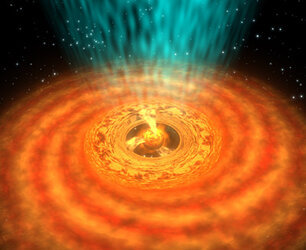
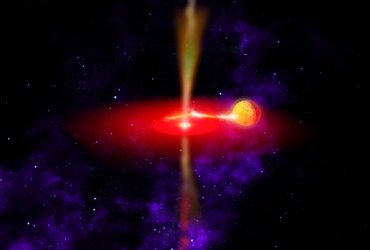
Using XMM-Newton, Bhattacharyya and his colleague Tod Strohmayer observed a binary system known as Serpens X-1, which contains a neutron star and a stellar companion. They studied a spectral line from hot iron atoms that are whirling around in a disc, just beyond the neutron star’s surface, at 40% the speed of light.
Previous X-ray observatories detected iron lines around neutron stars, but they lacked the sensitivity to measure the shapes of the lines in detail.

Thanks to XMM-Newton’s large mirrors, Bhattacharyya and Strohmayer found that the iron line is broadened asymmetrically by the gas’s extreme velocity, which smears and distorts the line because of the Doppler effect and beaming effects predicted by Einstein’s special theory of relativity. The warping of space-time by the neutron star’s powerful gravity, an effect of Einstein’s general theory of relativity, shifts the neutron star’s iron line to longer wavelengths.
"We have seen these asymmetric lines from many black holes, but this is the first confirmation that neutron stars can produce them as well. It shows that the way neutron stars accrete matter is not very different from that of black holes, and gives us a new tool to probe Einstein’s theory," says Strohmayer.
A group led by Edward Cackett and Jon Miller of the University of Michigan, which includes Bhattacharyya and Strohmayer, used Suzaku’s superb spectral capabilities to survey three neutron-star binaries: Serpens X-1, GX 349+2, and 4U 1820-30. This team observed a nearly identical iron line in Serpens X-1, confirming the XMM-Newton result. It detected similarly skewed iron lines in the other two systems as well.

"We’re seeing the gas whipping around just outside the neutron star’s surface," says Cackett. "And since the inner part of the disc obviously cannot orbit any closer than the neutron star’s surface, these measurements give us a maximum size of the neutron star’s diameter. The neutron stars can be no larger than 29 to 33 km across, results that agree with other types of measurements."
"Now that we have seen this relativistic iron line around three neutron stars, we have established a new technique," adds Miller. "It’s very difficult to measure the mass and diameter of a neutron star, so we need several techniques to work together to achieve that goal."
Knowing a neutron star’s size and mass allows physicists to describe the 'stiffness' (or equation of state) of matter packed inside these incredibly dense objects. Besides using these iron lines to test Einstein’s general theory of relativity, astronomers can use them to probe conditions in the inner part of a neutron star’s accretion disc.
Notes for editors:
The paper that deals with results from XMM-Newton titled ‘Evidence for a Broad Relativistic Iron Line from the Neutron Star Low Mass X-ray binary Serpens X-1’, by Bhattacharyya and Strohmayer, appeared in the Astrophysical Journal Letters on 1 August 2007.
The Suzaku paper ‘Relativistic Iron emission lines in neutron star low-mass X-ray binaries as probes of neutron star radii’ by E. Cackett, J. Milleri, S. Bhattacharya, J. Grindlay, J. Homan, M. van der Klis, T. Strohmayer and R. Wijnands has been submitted for publication in the same journal (Astrophysical Journal).
XMM-Newton, ESA’s space-borne X-ray observatory is the biggest scientific satellite ever built in Europe. Its telescope mirrors are the most sensitive ever developed in the world, and with its sensitive detectors, it sees much more than any previous X-ray satellite.
XMM-Newton was designed and built to return data for at least a decade. It has detected more X-ray sources than any previous satellite and is helping solve many cosmic mysteries of the violent Universe, from what happens in and around black holes to the formation of galaxies in the early Universe.
The satellite uses over 170 wafer-thin cylindrical mirrors spread over three telescopes. Its orbit takes it almost a third of the way to the Moon, so that astronomers can enjoy long, uninterrupted views of celestial objects.
Suzaku is the fifth Japanese X-ray astronomy satellite. It was developed at the Institute of Space and Astronautical Science of Japan Aerospace Exploration Agency (ISAS/JAXA) in collaboration with the USA (NASA/Goddard Space Flight Center, MIT Massachusetts Institute of Technology) and Japanese institutions and launched on 10 July 2005, from JAXA Uchinoura Space Centre.
For more information:
Tod Strohmayer, NASA Goddard Space Flight Center, USA
Email: Stroh @ milkyway.gsfc.nasa.gov
Sudip Bhattacharyya, University of Maryland, USA
Email: Sudip @ milkyway.gsfc.nasa.gov
Norbert Schartel, ESA XMM-Newton Project Scientist
Email: Norbert.Schartel @ sciops.esa.int