Double vortex at Venus South Pole unveiled!
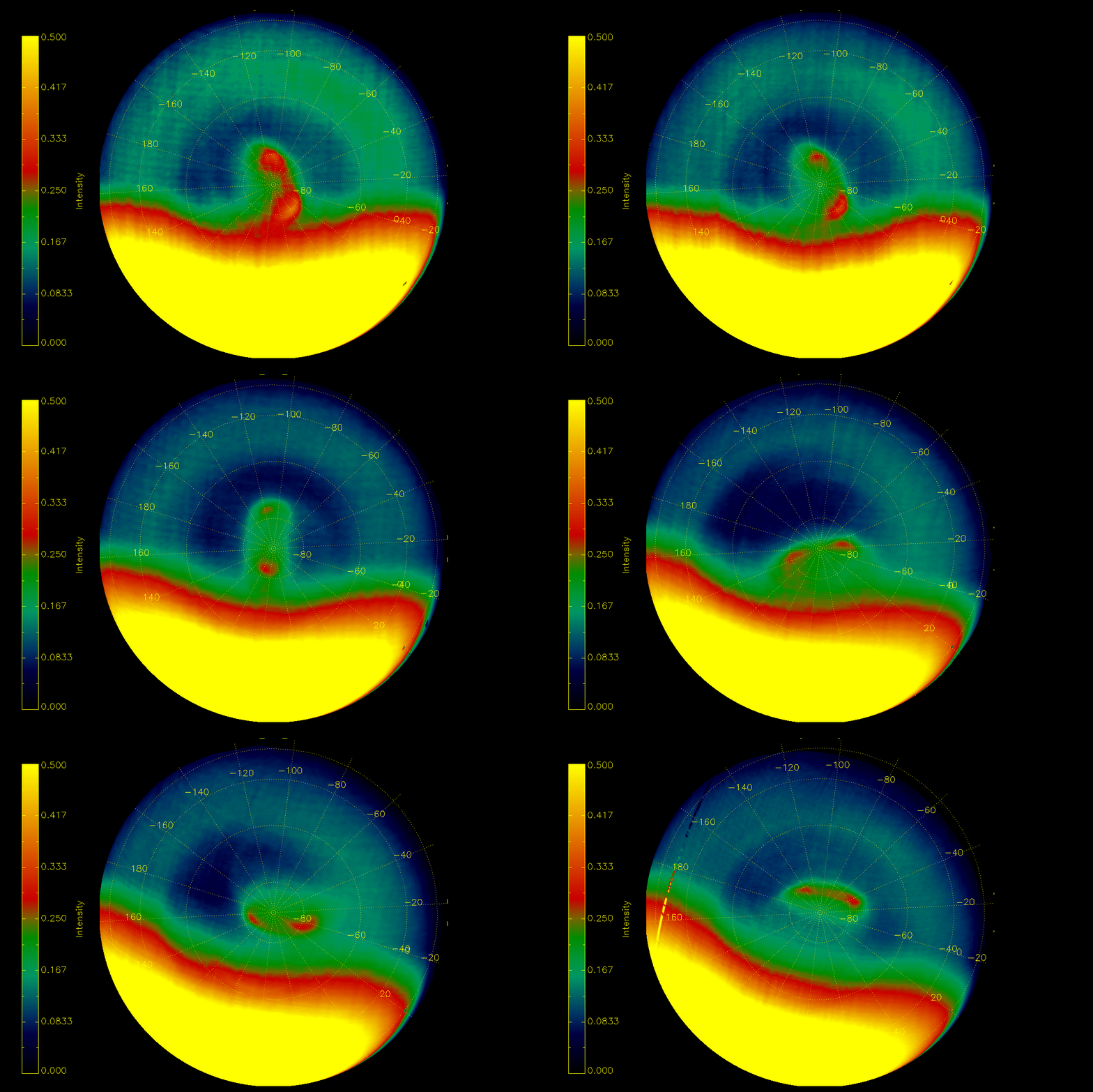
ESA’s Venus Express data undoubtedly confirm for the first time the presence of a huge 'double-eye' atmospheric vortex at the planet's south pole. This striking result comes from analysis of the data gathered by the spacecraft during the first orbit around the planet.
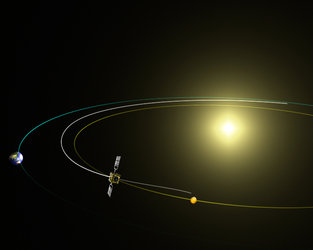
On 11 April this year, Venus Express was captured into a first elongated orbit around Venus, which lasted 9 days, and ranged between 350 000 and 400 kilometres from Venus' surface. This orbit represented for the Venus Express scientists a unique opportunity to observe the planet from large distances. This made it possible to obtain first clues about the Venusian atmospheric dynamics on a global scale, before the spacecraft got closer and started observing the planet in greater detail.

During this first orbit – called the 'capture orbit' – some of the Venus Express instruments were used to perform the first observations at different distances from Venus, for a few hours per time on six different slots between 12 and 19 April 2006.
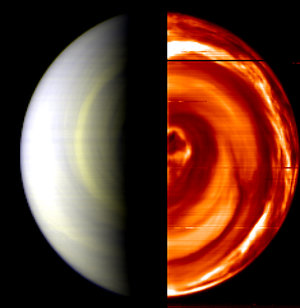
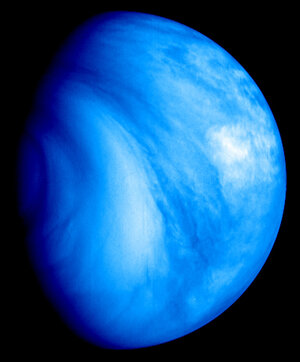
Amazing infrared, visible and ultraviolet images of the Venusian globe already reveal several atmospheric features of great interest. The most striking of these is a huge, double-eye atmospheric vortex over the south pole, not dissimilar from the equivalent structure present at the north pole – the only one previously studied in some detail.

Only glimpses of the stormy atmospheric behaviour at the south pole were obtained by previous missions (Pioneer Venus and Mariner 10), but such a double-eye structure was never clearly seen before now.
High velocity winds are known to spin westwards around the planet, and to take only four days to complete a rotation. This 'super-rotation', combined with the natural recycling of hot air in the atmosphere, would induce the formation of a vortex structure over each pole. But why two vortexes?

"We still know very little about the mechanisms by which the super-rotation and the polar vortexes are linked," said Håkan Svedhem, ESA’s Venus Express Project Scientist. "Also, we are still not able to explain why the global atmospheric circulation of the planet results in a double and not single vortex formation at the poles. However the mission is just at the beginning and it's doing fine; we expect this and many other long-standing mysteries to be addressed and possibly solved by Venus Express," he added. Atmospheric vortexes are very complex structures that are very difficult to model, even on Earth.
Thanks to these first pictures, it has also been possible to observe the presence of a collar of cold air around the vortex structure, possibly due to the recycling of cold air downwards.
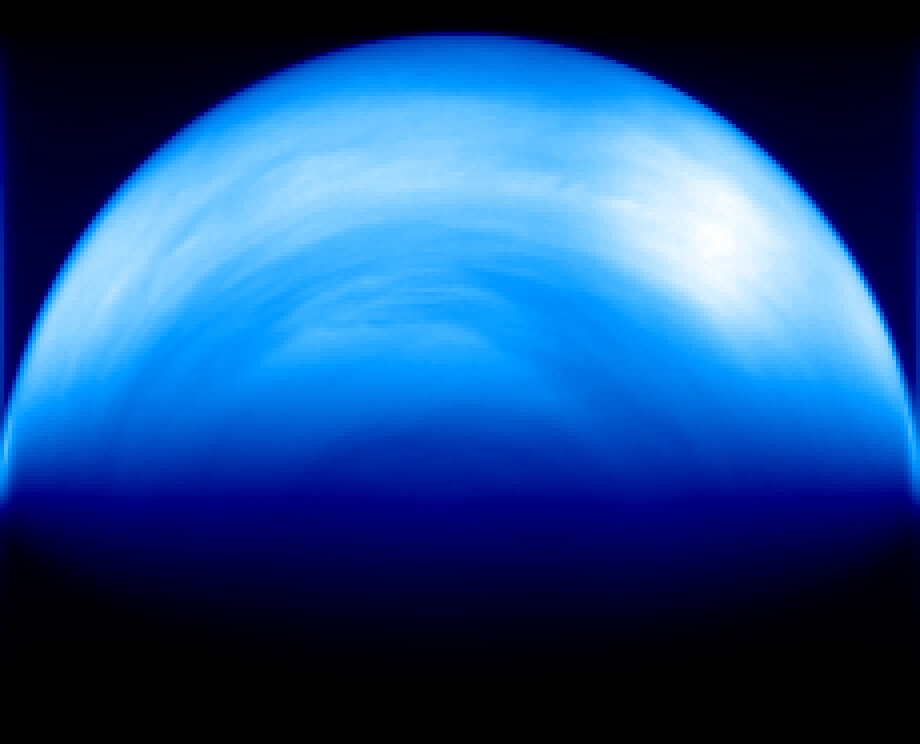
Views of the southern hemisphere of Venus in visible and ultraviolet light show interesting atmospheric stripe-like structures. Spotted for the first time by Mariner 10 in the 1970s, they may be due to the presence of dust and aerosols in the atmosphere, but their true nature is still unexplained. "Venus Express has the tools to investigate these structures in detail," added Svedhem. "Studies have already begun to dig into the properties of the complex wind fields on Venus, to understand the atmospheric dynamics on local and global scales."
Venus Express also made use for the first time ever from orbit of the so-called 'infrared windows' present in the atmosphere of Venus – if observed at certain wavelengths, it is possible to detect thermal radiation leaking from the deepest atmospheric layers, revealing what lies beneath the dense cloud curtain situated at about 60 kilometres altitude.
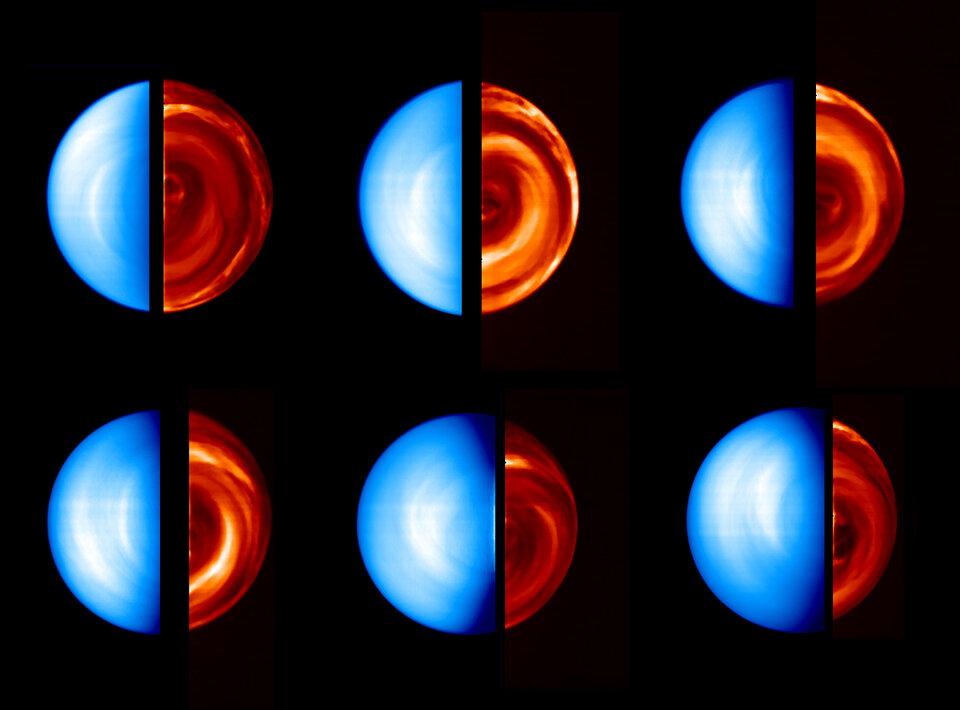
The first infrared images making use of the ‘windows’ show complex cloud structures, all revealed by the thermal radiation coming up from different atmospheric depths. In the colour scheme shown in the image at right, the brighter the colour (that is, the more radiation comes up from the lower layers), the less cloudy is the observed area.
During capture orbit, preliminary data about the chemical composition of the atmosphere were also retrieved. Venus’ atmosphere is mainly composed of carbon dioxide (CO2). The incoming solar radiation dissociates this molecule into carbon monoxide (CO) and oxygen in the upper atmospheric layers. In fact, Venus Express has already spotted the presence of an oxygen (O2) airglow high in the atmosphere. However, Venus Express has revealed the presence of carbon monoxide as low as the cloud-layer top.
Scientists will continue the data analysis and retrieval to understand the phenomenon, which is very important to clarify the complex chemical processes and cycles at work in the atmosphere of Venus under the influence of solar radiation.

Since 7 May 2006 Venus Express has been circling the planet in its final 24-hour orbit, ranging between 66 000 and 250 kilometres from Venus - therefore at much closer distances with respect to the capture orbit. Venus Express scientists are now analysing the new data coming in, which already show what seems to be exciting new features. “We have never seen Venus in such great detail so far. We are eagerly waiting for these new data to be available,” concluded Svedhem.
Note to editors:
On 28 June 2006, from 10:00 to 12:00, Venus Express scientists gathering at ESA's Space Operations Centre (ESOC) in Darmstadt, Germany, will be available for real-time phone interviews. Interested media are invited to call the following numbers for the interview set-up:
ESOC Communication Office
+49 61 5190 2266
+49 61 5190 2861
For more information:
Håkan Svedhem, ESA Venus Express Project Scientist
Email: Hakan.Svedhem @ esa.int