Finding Hera’s way: ESA’s Flight Dynamics team into action
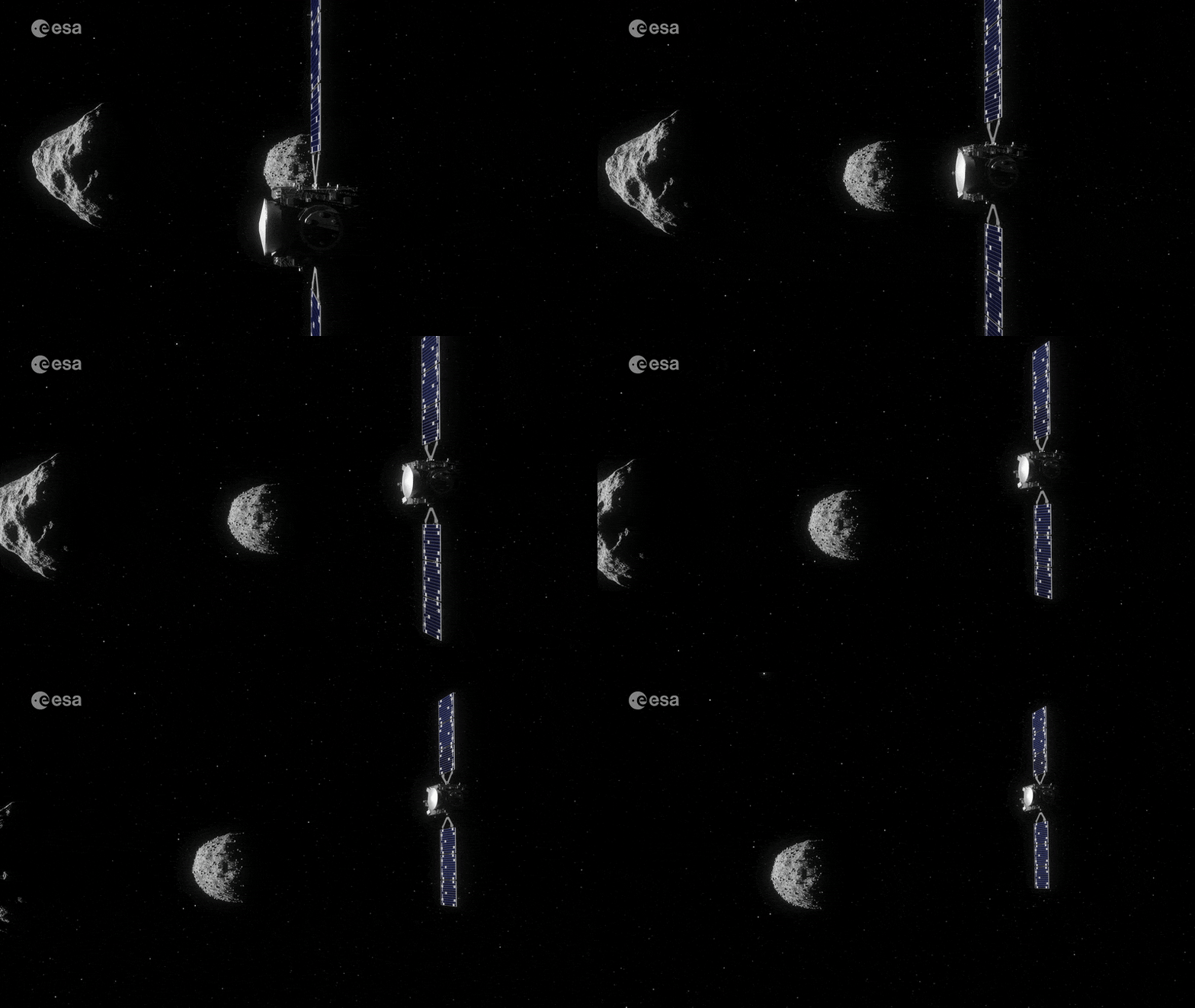
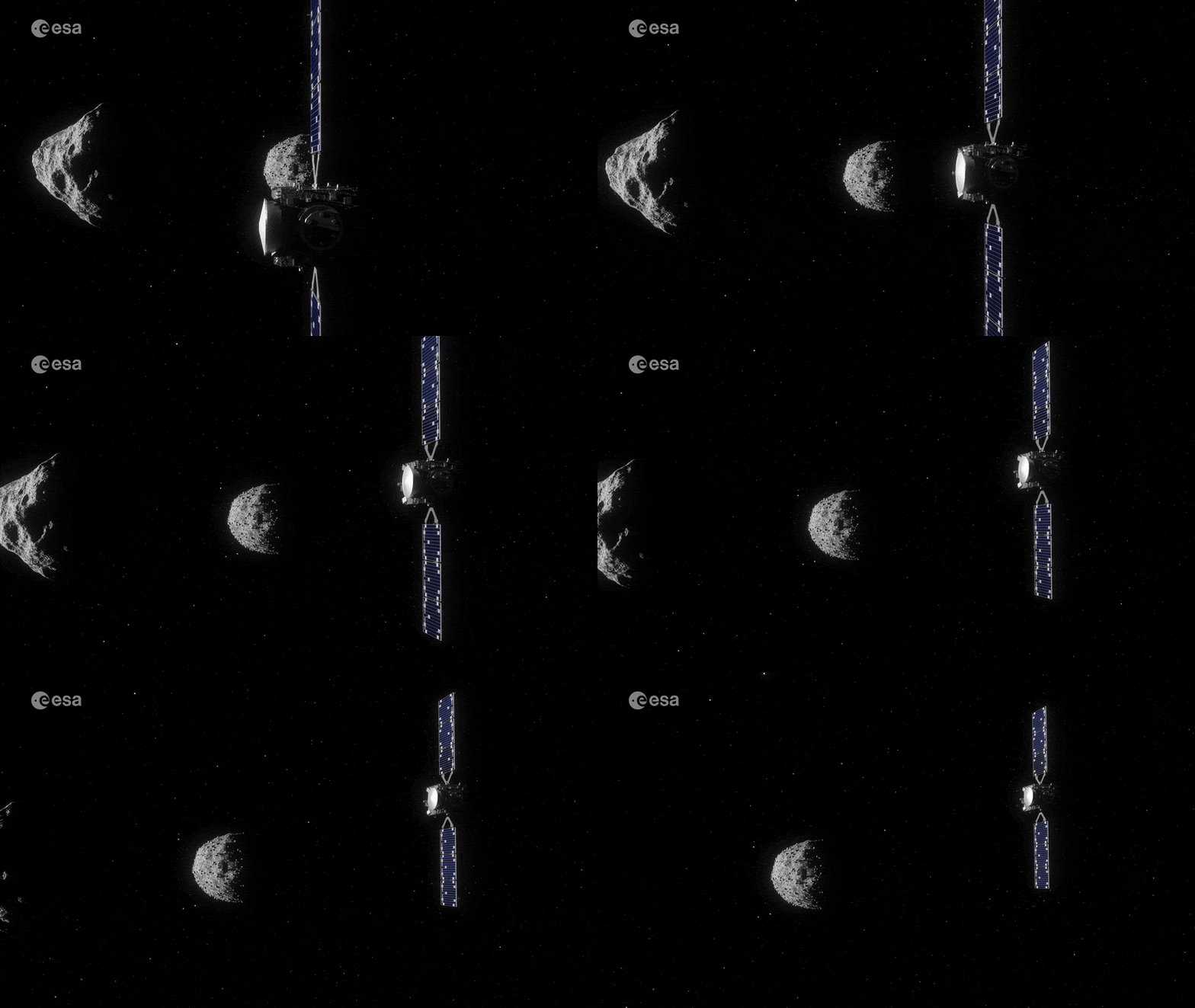
The European Space Agency’s Hera planetary defence mission team is preparing to light a fire in the sky. On the early morning of 15 October the small-car-sized spacecraft will burn its Orbit Control Thrusters in the direction of its target asteroid system for a total of 93 minutes continuously. This braking manoeuvre will bring it near to matching the orbital velocity of the Didymos binary asteroids.
A week later a second, shorter, burn is scheduled to fine-tune the spacecraft’s adjusted orbit as required. In the meantime the Hera-tasked segment of ESA’s Flight Dynamics team will go to work: around 10 people per shift out of a more than 50-strong assigned team of top mathematicians, physicists and aerospace engineers, occupying two entires floor of the European Space Operations Centre in Darmstadt, Germany.
The personnel making up ESA’s Flight Dynamics Division are Europe’s navigators of space, playing an essential role in any mission possessing a complex trajectory.

The role of Flight Dynamics is firstly to determine the position and orbit of a given spacecraft as precisely as possible and then – based on that determination – to come up with a set of instructions to move the spacecraft to the wherever it next needs to be, in the form of telecommands to be uplinked to the spacecraft.
Multi-mission support
Flight Dynamics Engineer Michael Mueller explains: “The team performs Flight Dynamics operations for all ESA operated Science missions, including interplanetary missions and observatories, and now our agency’s first Space Safety mission as well!

“So as Hera arrives we will also be working on the BepiColombo mission’s approach to Mercury and during subsequent Hera proximity operations we will also have the launch of ESA’s Plato exoplanet-monitoring observatory, which will need to be shepherded to the Sun-Earth Lagrange point L2, 1.5 million kilometres from Earth.”
During Hera’s two-year cruise phase the main task of Flight Dynamics was to oversee the mission’s spring 2025 Mars flyby which enabled to change its direction while acquiring extra speed from the red planet. The rest of the cruise was as routine as a deep space mission gets. But this is set to change once Hera arrives.

Getting it right
He adds: “For Hera – starting with these braking manoeuvres and then moving on to the asteroid phase of active scientific observations – we have a total of six different teams to actively look at the data coming in from the spacecraft, including sanity checks in the form of multiple independent assessments.
“Over the course of Hera’s approach, in addition to estimating Hera’s orbit, the state of the asteroid system will also be estimated: this includes the orbit of the system within the Solar System, the relative orbit of the main asteroid Didymos and its moon Dimorphos, the rotational state of these asteroids as well as related parameters such as the masses of the asteroids.

“This will be done using radiometric data gathered from the spacecraft signals as they are acquired from ground stations but also from the images returned by Hera’s onboard camera – which will become of growing usefulness the closer the mission comes to the asteroids and the more surface features we can discern, to be used as reference points.
“Next year our work will get more complicated still, because we will also have to estimate the orbits of the two CubeSats that will be deployed from Hera.

“Our task is not simply analysis however; the end result of our work is a detailed set of telecommands ready for subsequent uplink to control the on-board guidance navigation and control system as well as commands for one of Hera’s cameras. In additional products that we produce support the commanding of other payloads and operations of ground antennas. It might take 10 hours of detailed work at a time to prepare this material.”
The core inputs the team has to work with – acquired via one of ESA’s four 35-m diameter deep space antennas dotted across the globe – include onboard telemetry variables such as the spacecraft attitude (or pointing direction) and asteroid images to fix Hera’s position. But the signal that transmits this telemetry also contains essential information in its own right. The signal’s travel time allows the measurement of its range away from our planet while the Doppler shift of the signal itself – like a police radar gun – reveals how fast the spacecraft is moving away from (or towards) Earth.

And periodically, by measuring the signal range from two ground stations at once – known as delta - Differential One-way Range – the spacecraft’s sideways motion can also be discerned, performed on a regular basis during Hera’s pre-arrival cruise phase.
Self-driving spacecraft
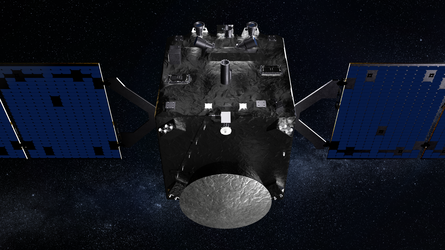
“Compared to the mission’s closest predecessor, ESA’s Rosetta comet mission, Hera possesses much greater onboard autonomy,” adds Michael Mueller. “Rosetta returned its data and then we had to perform all orbital calculations on the ground. Hera, by contrast, operates on a more autonomous basis, with its degree of autonomy increasing as it draws nearer to the asteroids.”
In November and December Hera will go through its ‘early characterisation phase’, to acquire baseline measurements of the Didymos asteroid and its Dimorphos moonlet from a relatively safe distance of 25-30 km away.

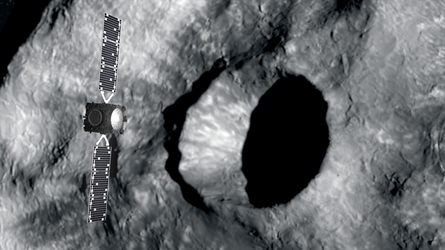
Later in December Hera will achieve a minimum distance of just 10 km for its ‘detailed characterisation phase’. Early next year it will deploy its two CubeSats. This is followed by its ‘close observation phase’, to draw as close as 4 km. Finally an experimental phase is planned that targets to fly to just a single kilometre away distance from the smaller asteroid moonlet.
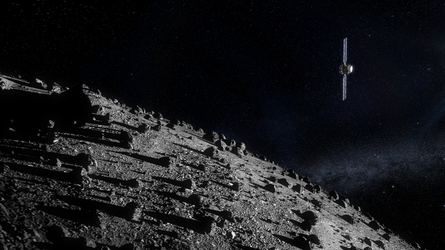
Michael Muller notes: “This is a big technical leap forward but had to be done to perform science. Once the asteroids fill its field of view, Hera will be optically tracking surface features on the asteroids as a means of determining its own orbital position and motion – though of course this had to be rigorously tested using simulations beforehand.”

Asteroid unknowns
The exact state of the smaller asteroid, Dimorphos, remains unknown since it was deliberately impacted by NASA’s DART spacecraft on 26 September 2022.
Michael Mueller adds: “There’s a lot of uncertainty, especially in terms of the asteroid’s degree of tumbling due to the collision. We cannot simulate all probabilities but have to restrict ourselves to the more likely outcomes. The prospect of some impact debris remaining in Dimorphos’s vicinity has not been entirely ruled out. So potentially there might be surprises ahead, but this is an adventure we’re looking forward to!”
For instance, in the case of Rosetta, the spacecraft ran into problems as it approached comet 67P/Churyumov–Gerasimenko. Its startrackers were blinded by the comet’s surrounding halo of dust manifesting as false stars (although Dimorphos is a less dusty asteroid, not a comet).
“A large fraction of our team have experience of Rosetta, and we’re looking forward to our first view of Hera’s asteroids, as well as working along with the mission’s CubeSat Mission Operation Centre, based in ESA’s European Space Security and Education Centre, ESEC, in Redu, Belgium, and the CubeSat Flight Dynamics team at CNES in Toulouse, France, who will be performing the Flight Dynamics operations of the CubeSats using the orbit estimates that our team will provide them – an unprecedented operation of three different spacecraft in operation around two separate asteroids!”


Access the video