• → European Space Agency

      • Space for Europe
      • Space News
      • Space in Images
      • Space in Videos
    • About Us

      • Welcome to ESA
      • DG's News and Views
      • For Member State Delegations
      • Business with ESA
      • ESA Exhibitions
      • ESA Publications
      • Careers at ESA
    • Our Activities

      • Space News
      • Observing the Earth
      • Human Spaceflight
      • Launchers
      • Navigation
      • Space Science
      • Space Engineering
      • Operations
      • Technology
      • Telecommunications & Integrated Applications
    • For Public

    • For Media

    • For Educators

    • For Kids

    • ESA

    • Launch Special

    • Herschel

    • Planck

    • ESA Science

    • About Herschel

      • Herschel at a glance
      • Science objectives
      • Herschel highlights
      • History of infrared astronomy
    • The infrared Universe

      • Why the infrared?
      • More about the infrared
      • The infrared revolution
    • Spacecraft and telescope

      • Vital stats
      • The largest infrared space telescope
      • Instruments
      • Cutting-edge spacecraft
    • The mission

      • Journey
      • Early operations
      • Operating Herschel
    • Meet the team

      • Herschel Project Scientist: An interview with Göran Pilbratt
      • Herschel and Planck Programme Manager: An interview with Thomas Passvogel
    • Multimedia
    • Herschel images
    • Herschel videos

    ESA > Our Activities > Space Science > Herschel

    Exploding stars can make good dust factories

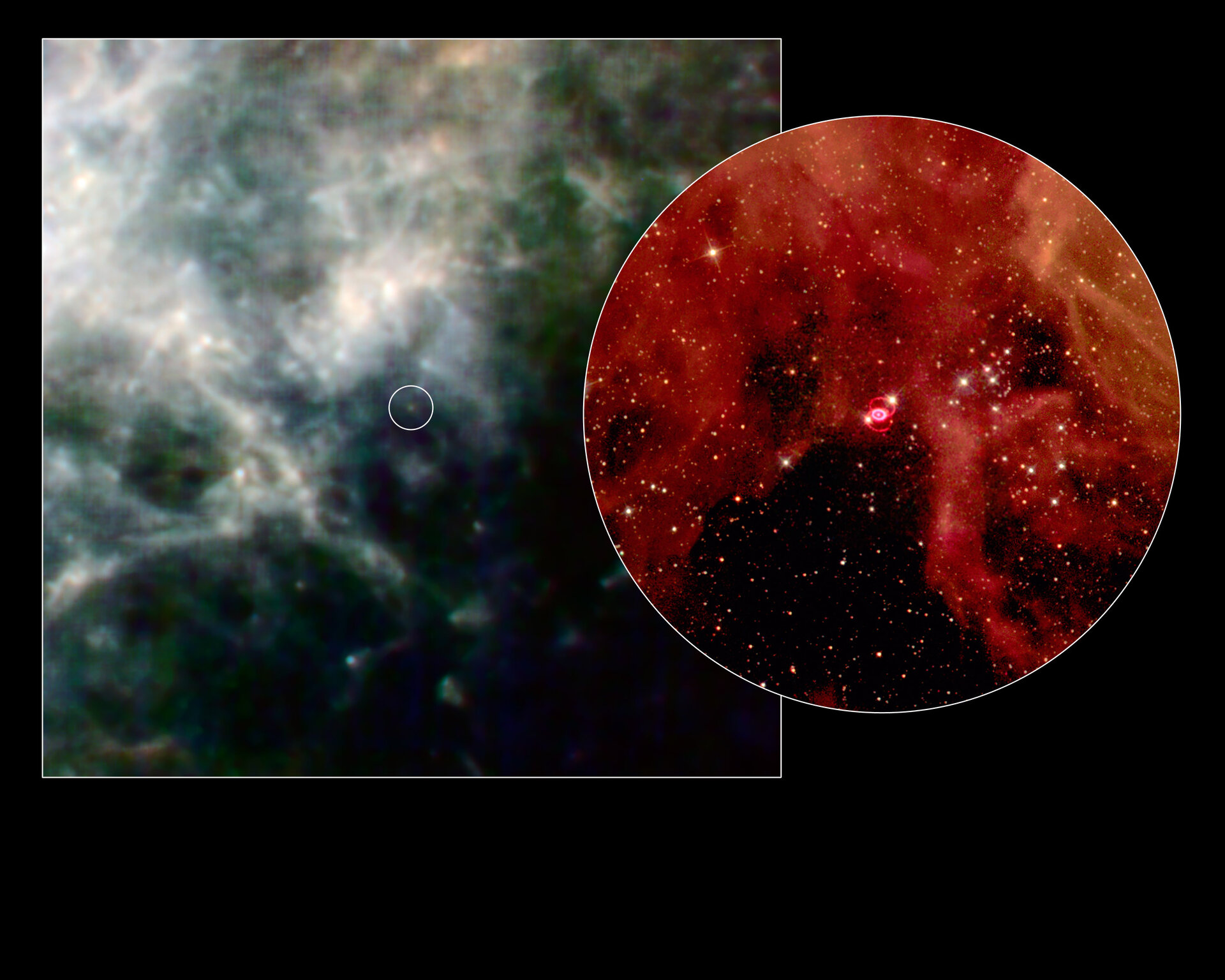
    Herschel and Hubble view of Supernova 1987A
    7 July 2011

    ESA’s Herschel space observatory has discovered that titanic stellar explosions can be excellent dust factories. In space, the dust mixes with gas to become the raw material for new stars, planets and, ultimately, life. This discovery may solve a mystery of the early Universe.

    The discovery was made while Herschel was charting emission from cold dust in the Large Magellanic Cloud, a small galaxy near to the Milky Way. It is the perfect observatory for the job because cold dust radiates far-infrared light, the wavelengths Herschel is designed to detect.

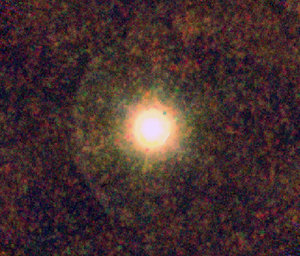
    Herschel saw a spot of light at the location of supernova 1987A, an exploding star first seen from Earth in February 1987, and the closest known supernova in the past 400 years.

    Since then, astronomers have been studying the remains of the explosion as its blast wave expands into its surroundings.

    Herschel’s images are the first clear-cut far-infrared observations of SN1987A. They reveal cold dust grains at about –250ºC, emitting more than 200 times the Sun’s energy.

    “The supernova remnant was much brighter at infrared wavelengths than we were expecting,” says Mikako Matsuura, University College London, who is the lead author on the paper detailing these results.
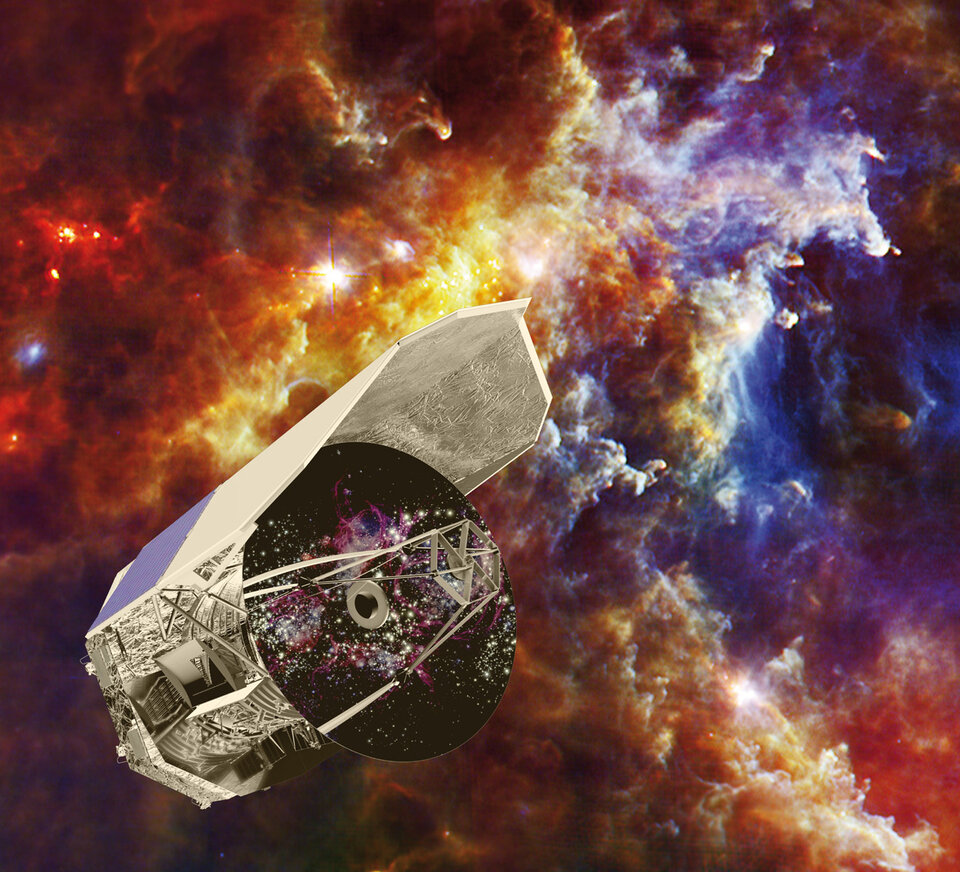
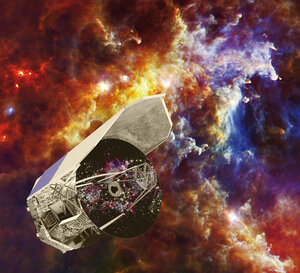
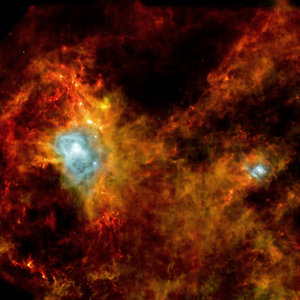
    Herschel and Rosette Nebula

    The remnant’s brightness was used to estimate the amount of dust. Surprisingly, there turned out to be about a thousand times more dust than astronomers had thought a supernova was capable of producing – enough to make 200 000 planets the size of Earth.

    The origin of dust in the Universe is of great interest. Its heavy atoms like carbon, silicon, oxygen and iron were not produced in the Big Bang and must have formed later.

    Although they are only a minor part of the Universe and our Solar System, they are the main constituents of rocky planets like Earth and thus of life itself: many of the atoms we are made of were once part of the dust in the Universe.

    However, it is not fully understood where this dust comes from, especially in the distant and thus young Universe, but now we have an indication.

    The many old red giant stars in today’s Universe are thought to be the major dust producers, with the grains condensing like soot in a chimney as warm gases flow away from the star.

    However, there were no such stars in the early Universe – yet we know there was already dust.

    Now Herschel has shown that supernovas can produce enormous amounts of dust: the astronomers speculate that the dust condenses from the gaseous debris as it expands from the explosion and cools.

    Since there were plenty of supernovas in the young Universe, this could help to explain the origin of dust seen at those times.

    “These observations provide the first direct evidence that supernovas can produce the dust seen in young galaxies at great distance,” says Göran Pilbratt, ESA’s Herschel Project Scientist.

    “It is a significant result and shows yet again the value of opening a unique window onto the Universe..”



    Further information

    Rate this

    Views

    Share

    • Currently 0 out of 5 Stars.
    • 1
    • 2
    • 3
    • 4
    • 5
    Rating: 0/5 (0 votes cast)

    Thank you for rating!

    You have already rated this page, you can only rate it once!

    Your rating has been changed, thanks for rating!

    125
    Tweet
    • Herschel: ESA's giant infrared observatory
    • More about
    • Herschel overview
      • Other Herschel First Science Stories
      • Online Showcase of Herschel Images OSHI
      • Herschel on YouTube
      • Inside Herschel
      • Herschel mission objectives
      • Related articles
        • Astronomers searching for oxygen can breathe more easily
          • Enceladus rains water onto Saturn
            • Raging storms sweep away galactic gas
              • Herschel links star formation to sonic booms
                • Herschel finds less dark matter but more stars
                  • Andromeda’s once and future stars
                    • Recipe for water: just add starlight
                      • Herschel and Planck win the French Grand Prix
                        • Herschel finds a hole in space
                          • Herschel reveals the hidden side of star birth
                            • Herschel takes the temperature of an interstellar cloud
                              • Tracing the Milky Way’s hidden reservoirs of gas
                                • Herschel resolves the cosmic infrared fog
                                  • Baby stars in the Rosette cloud
                                    • Inside the dark heart of the Eagle
                                      • Herschel views deep-space pearls on a cosmic string
                                      • Read more
                                        • Observations: Seeing in infrared wavelengths
                                          • Why infrared astronomy is a hot topic
                                            • L2, the second Lagrangian Point
                                            • In depth
                                            • This story in depth
                                            • Herschel in depth

    Connect with us

    • RSS
    • Youtube
    • Twitter
    • Flickr
    • G+
    • Facebook
    • Livestream
    • Subscribe
    • App Store
    • LATEST ARTICLES
    • · Proba-V opens its eyes
    • · First new Galileo satellite arrive…
    • · Next destination: space
    • · Leak repaired on International Spa…
    • · After Chelyabinsk: European expert…
    • FAQ

    • Jobs at ESA

    • Site Map

    • Contacts

    • Terms and conditions