Mars Express PFS spectrometer back at work
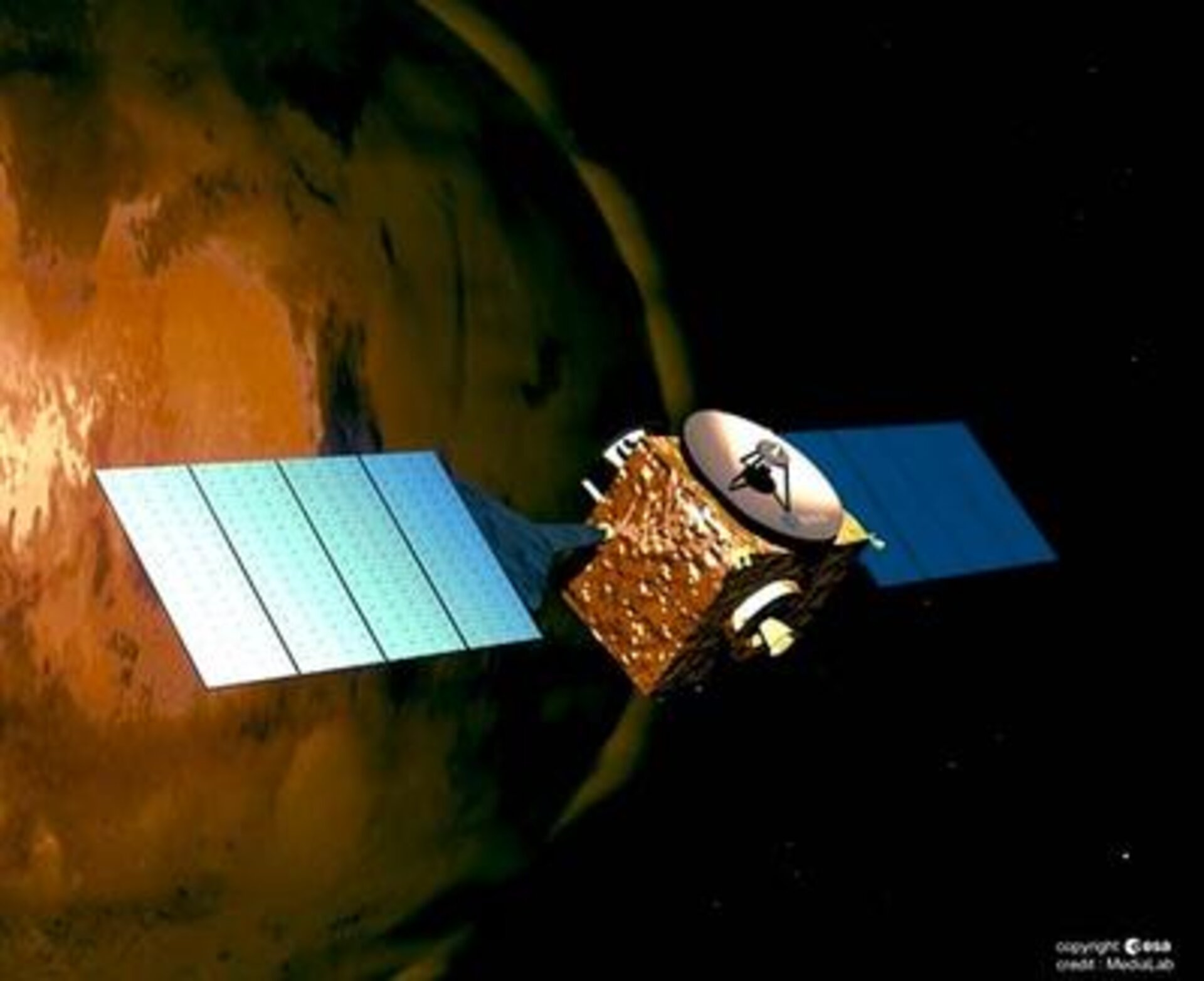
The Planetary Fourier Spectrometer (PFS) on board ESA’s Mars Express spacecraft is now back in operation after a malfunction, reported a few months ago.
The instrument had been successfully investigating the chemical composition of the Martian atmosphere since the beginning of 2004, when Mars Express began orbiting the Red Planet.
PFS is a very sensitive instrument, capable of measuring the distribution of the major gaseous components of the atmosphere, the vertical distribution of their temperature and pressure, and determining their variation and global circulation during the different Martian seasons.
PFS is also capable of detecting minor gaseous species and the presence of dust in the atmosphere and, during favourable observing conditions, even deducing the mineralogical composition of the soil.
PFS was the first instrument ever to make direct 'in situ' measurements of methane in the atmosphere of Mars, and provided first indications of traces of formaldehyde, both candidate ingredients for life.
To identify the nature of chemical compounds of the Martian atmosphere and their physical status, PFS detects the distinctive infrared radiation re-emitted by different molecules when they are exposed to the light of the Sun.
The complex PFS instrument uses the interferometry technique, a high-precision measurement method in which beams of electromagnetic radiation are split and subsequently recombined after travelling different path-lengths. The beams interfere and produce an ‘interference pattern’.
This pattern, or ‘interferogram’, is then used to measure physical properties such as temperature, pressure and chemical composition.
The PFS instrument was unable to produce scientific data from July to September 2005. A series of tests and investigations took place between September and October this year.
The ‘pendulum motor’, used to drive various elements in the instrument optics, was shown to be at fault. The recovery was made possible through using internal instrument redundancy.
After switching to the instrument’s back-up motor, more powerful than the first one - the instrument has been shown to be able to produce science data just as before. Following this recovery activity, PFS will start to take new measurements routinely in early November 2005.
Notes to editors:
PFS is a ‘double pendulum’ interferometer. The incident radiation is divided into two beams by a mirror and then filtered before being directed into two separate interferometers. The interferometers are positioned with their planes of operation one above the other so that a single motor can be used to move both pendulums.
PFS measurements have a spatial resolution ranging from 7 to 12 kilometres when Mars is observed from an altitude of 250 kilometres.
For more information:
Prof. Vittorio Formisano, PFS Principal Investigator
IFSI-CNR, Rome, Italy
E-mail: formisan @ nike.ifsi.rm.cnr.it
Fred Jansen, ESA Mars Express Mission Manager
E-mail: fjansen @ rssd.esa.int
Agustin Chicarro, ESA Mars Express Project Scientist
E-mail: agustin.chicarro @ esa.int
Enrico Flamini, ASI Mars Express Mission Manager
E-mail: enrico.flamini @ asi.it