




 Germany
 Austria
 Belgium
 Denmark
 Spain
Spain
 Estonia
 Finland
 France
 Greece
 Hungary
 Ireland
 Italy
Italy
 Luxembourg
 Norway
 The Netherlands
 Poland
 Portugal
 Czechia
 Romania
 United Kingdom
 Slovenia
 Sweden
 Switzerland










Proba-V will put European gallium nitride to its first space test
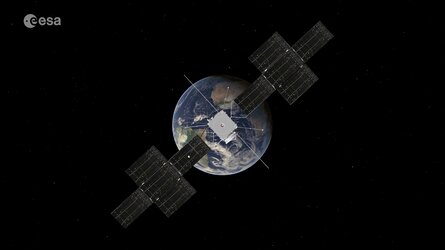
Proba-V, ESA’s small satellite for global vegetation mapping, will be the first space mission to fly European gallium nitride technology. This novel material’s high power capacity makes it the most promising semiconductor since silicon.
Already in everyday use as light-emitting diodes, gallium nitride (GaN) attracts great interest within the world of integrated circuits. It operates reliably at much higher voltages and temperatures than silicon or the widely-employed gallium arsenide (GaAs).
Applied to space, GaN could mean a communications revolution, offering a five- to ten-fold increase in satellite signal strength.
An enabling technology for space

Because GaN can operate at higher temperatures than silicon or GaAs, it would make designing satellites easier, halving the size of radiating panels required for dumping waste heat. As an added benefit, the semiconductor is inherently radiation-resistant.
Fostering innovation to boost European industrial competitiveness is one of ESA’s core tasks. The Agency has identified gallium nitride as a key ‘enabling technology’ for space, establishing a European consortium to manufacture high-quality GaN devices for space uses: the ‘GaN Reliability Enhancement and Technology Transfer Initiative’ (GREAT2).
“Our GREAT2 supply chain produced its first prototypes at the start of this year,” said Andrew Barnes, GREAT2 technical officer of ESA’s Product Assurance and Safety Department.
“At the same time, Proba-V was offering slots for technology demonstration payloads. We’ve therefore been able to obtain a valuable early opportunity for in-flight testing.”
V for Vegetation

Proba-V is the latest in ESA’s ‘Project for Onboard Autonomy’ small satellite series, offering early flight demonstration opportunities to new technologies from European firms.
The mission will host a cut-down version of the multispectral Vegetation instrument flying on France’s Spot-4 and Spot-5. Proba-V will maintain the flow of land vegetation imagery to the Vegetation instrument’s well-established user community.
Tracking daily vegetation growth across all of Earth’s land, Proba-V will deliver three times greater image resolution than previous generations of the Vegetation sensor. This should yield a vast amount of data for such a small satellite – Proba-V will be less than a cubic metre in volume.
Proba-V’s communications antenna and transmitter are strictly limited in size as a consequence, presenting a potential bottleneck in getting imagery down from orbit into the hands of users. The mission will avoid this by using a compact, highly efficient X-band transmitter, along with onboard storage capacity and data compression techniques.
Putting GaN technology to work
“Proba-V had a couple of ‘guest technology’ slots free, but we decided to do something different,” explained Mr Barnes.
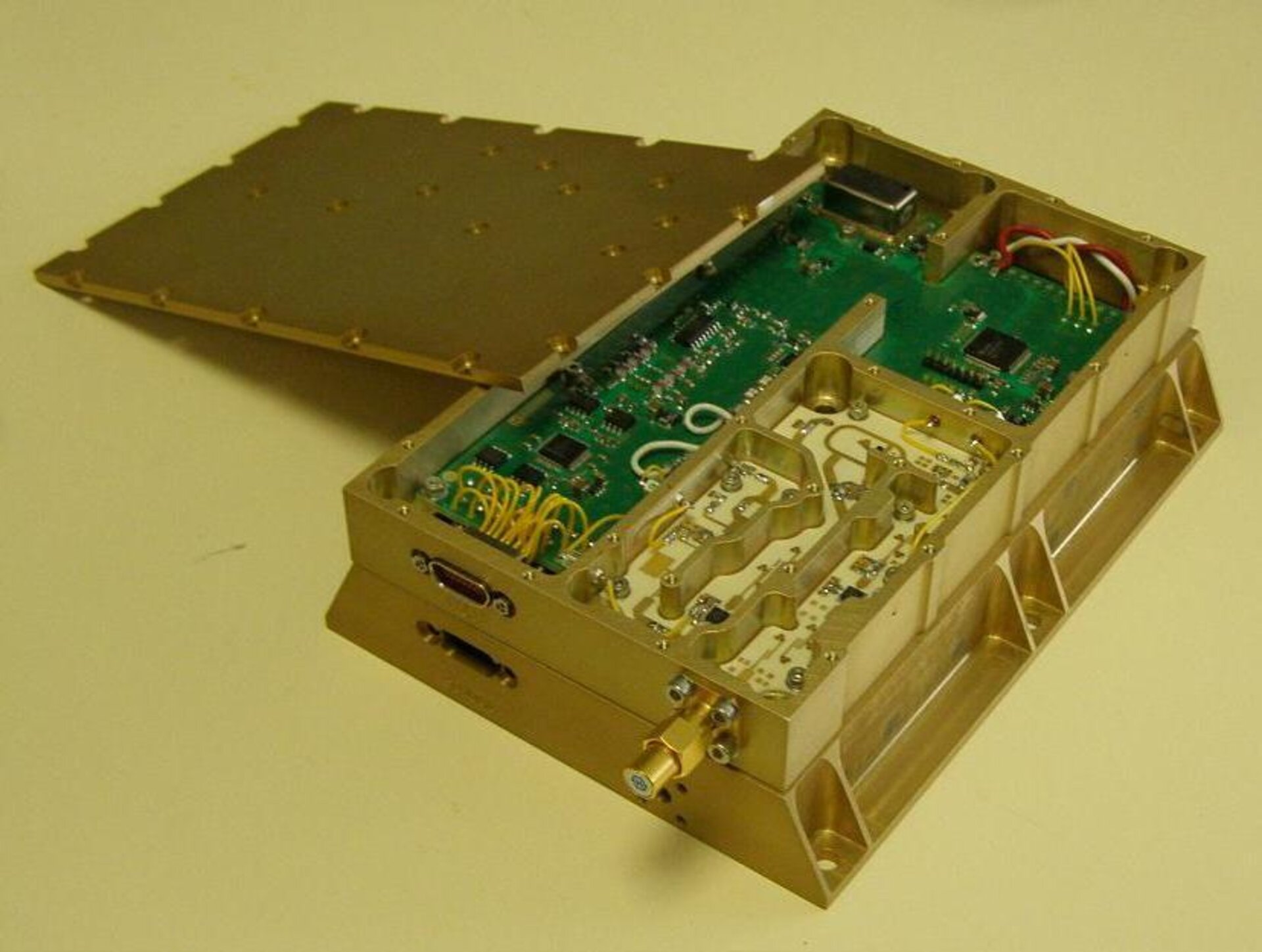
“Among the GREAT2 prototype designs is an X-band integrated circuit design. We proposed that we could, with various refinements, add an extra X-band transmitter incorporating a GaN amplifier sourced from GREAT2 to Proba-V’s initial pair of standard GaAs transmitters.”
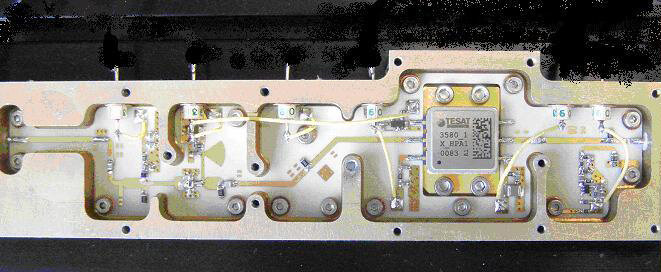
A prototype was rapidly put together for initial testing, with a prototype amplifier incorporated into an existing X-band transmitter developed for Proba-V in collaboration with the French space agency, CNES.
Follow-up testing on electrical and qualification models will follow before the transmitter’s flight model is integrated onto the satellite in about a year, for a launch scheduled in 2012.
“It’s a good result for Proba-V because it keeps room for an additional guest technology while boosting our overall communications robustness,” said Karim Mellab, Proba-V Mission Manager.
“As another advantage, this new transmitter has an adjustable power output. This will help optimise power consumption, a very important consideration for a satellite our size.”
Proba-V taking shape
The mission’s guest technology slot is being filled by a new space radiation detector, with a remaining slot due to be allocated later in the year. Proba-V itself is fast taking shape: Proba-V’s Structural and Thermal Model underwent testing last month at Intespace in Toulouse.
Gaining early flight experience through in-orbit demonstration on missions such as Proba-V is essential to accelerate the technology readiness level of GaN systems, and open the way toward employing them operationally on future space missions.