


ESOC: Past, current and future missions
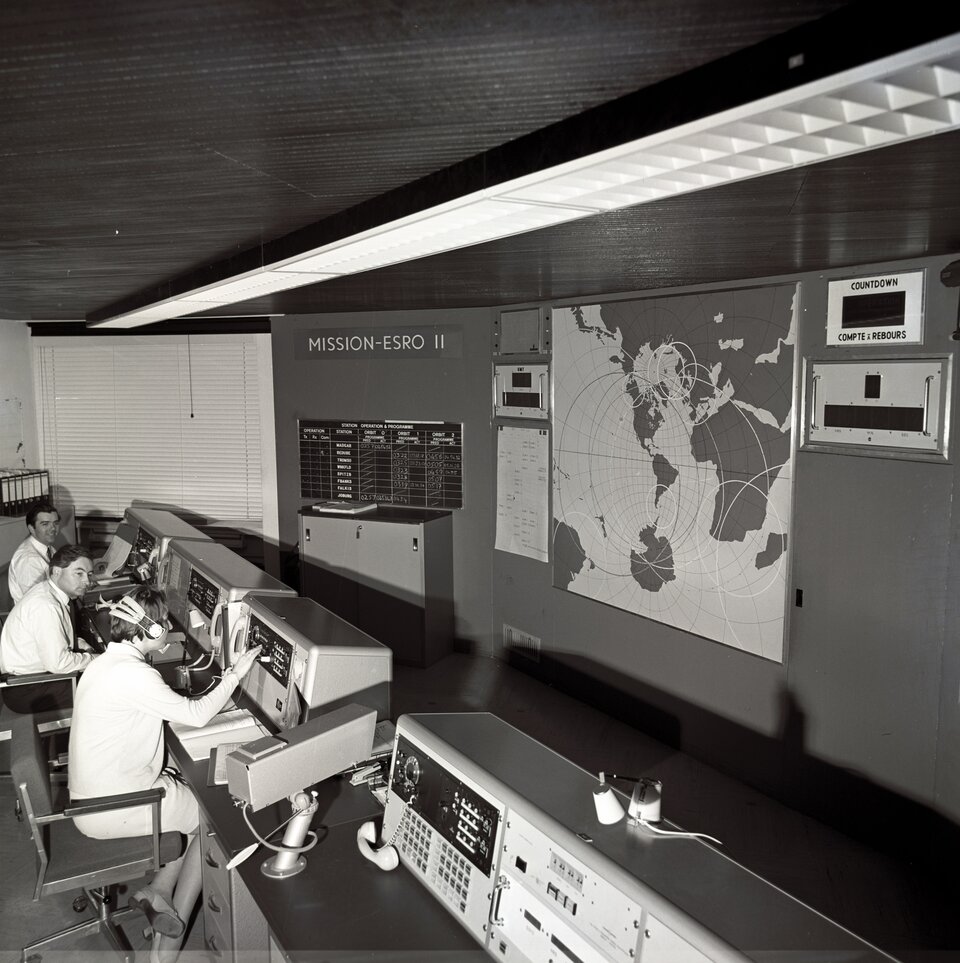
In September 1967, the European Space Operations Centre (ESOC) was formally inaugurated in Darmstadt, Germany, to provide satellite control for the European Space Research Organisation (ESRO) and the European Launcher Development Organisation (ELDO) – the two organisations that subsequently merged to create the European Space Agency (ESA).
By May 1968, ESOC was already conducting its first operations, controlling ESRO-2B, a scientific research satellite and the first in a long series of successful missions operated from ESOC for ESRO, and later ESA. Since then, ESOC has successfully operated over 90 missions.
The missions listed below were, are or will be operated from ESOC in Darmstadt, Germany, or with significant support from the teams based there.
Current missions operated from ESOC
| Name | Programme | Description | Number of spacecraft currently in operation | Launch date |
| BepiColombo | Planetary science | Mercury explorer | 1 | 20.10.2018 |
| Biomass | Earth observation | Measuring forest biomass | 1 | 29.04.2025 |
| Cluster II | Planetary science | Studying interactions between solar wind and Earth’s magnetic field | 2 | Satellites 2 & 3: 16.07.2000 Satellites 1 & 4: 09.08.2000 |
| CryoSat-2 | Earth observation | ESA's ice mission | 1 | 08.04.2010 |
| EarthCARE | Earth observation | ESA's cloud, aerosol and radiation mission | 1 | 28.05.2024 |
| Euclid | Astrophysics | Studying dark matter and energy | 1 | 01.07.2023 |
| ExoMars Trace Gas Orbiter | Solar & planetary explorers | Orbiting Mars –Studying Mars while providing crucial data relay | 1 | 14.03.2016 |
| Hera | Space safety | Europe's first planetary defence mission heading to a double-asteroid system | 1 | 07.10.2024 |
| Integral | Astrophysics | Gamma-ray observatory | 1 | 17.10.2002 |
| Juice | Planetary science | Jupiter Icy Moons Explorer | 1 | 14.04.2023 |
| Mars Express | Planetary science | Europe's first Mars orbiter | 1 | 02.06.2003 |
| Sentinel-1 | Earth observation | Europe's Copernicus programme – Radar Vision for Copernicus - Sentinel-1A, 1C, 1D | 3 | 1A: 03.04.2014 1C: 05.12.2024 1D: 04.11.2025 |
| Sentinel-2 | Earth observation | Europe's Copernicus programme – Colour vision for Copernicus - Sentinel-2A, 2B, 2C | 3 | 2A: 23.06.2015 2B: 07.03.2017 2C: 05.09.2024 |
| Sentinel-5P | Earth observation | Europe's Copernicus programme – Global air monitoring for Copernicus - Sentinel-5 Precursor | 1 | 13.10.2017 |
| Solar Orbiter | Solar & planetary explorers | Expanding our knowledge of solar physics | 1 | 10.02.2020 |
| Swarm | Earth observation | Geomagnetic surveyor | 3 | 22.11.2013 |
| XMM-Newton | Astrophysics | X-ray observatory | 1 | 10.12.1999 |
| That's 17 missions in total, comprising 24 spacecraft. | ||||
Notes:
- Cluster No. 2 (Salsa) reentered Earth's atmosphere on 9 Sep 2024, marking the end of this four-ship mission. Since then, Cluster No. 1 (Rumba) reentered on 22 Oct 2025. The remaining two satellites (No. 3, Samba, and No. 4, Tango) are being flown in 'caretaker mode' until their own reentries in 2026.
Future missions in preparation at ESOC
| Name | Programme | Description |
| Ariel | Astrophysics | Performing a chemical census of a large and diverse sample of exoplanets by analysing their atmospheres |
| Argonaut | Exploration | Europe’s lunar lander |
| Arrakihs | Astrophysics | Observation of low brightness galactic halos to study the archaeology of galaxies |
| CHIME | Earth observation | Europe's Copernicus Expansion programme – Copernicus Hyperspectral Imaging Mission for the Environment |
| CIMR | Earth observation | Europe's Copernicus Expansion programme – Copernicus Imaging Microwave Radiometer |
| CO2M* | Earth observation | Europe's Copernicus Expansion programme – Copernicus Anthropogenic Carbon Dioxide Monitoring |
| Comet Interceptor | Science | Study of a pristine comet |
| CRISTAL | Earth observation | Europe's Copernicus Expansion programme – Copernicus Polar Ice and Snow Topography Altimeter |
| Envision | Science | Understanding why Venus is so different from Earth |
| ExoMars Rosalind Franklin | Planetary science | ExoMars rover |
| FLEX | Earth observation | Fluorescence Explorer to map vegetation fluorescence and quantify photosynthetic activity |
| FORUM | Earth observation | ESA's thermal radiation mission |
| Harmony | Earth observation | Radar observations in tandem with Sentinel-1 |
| LISA | Astrophysics | First space-based observatory dedicated to studying gravitational waves |
| LSTM | Earth observation | Europe's Copernicus Expansion programme – Land Surface Temperature Monitoring |
| Plato | Astrophysics | Discover extrasolar planetary systems and terrestrial planets and study their host stars (Asteroseismology) |
| RAMSES | Space safety | Planetary defence mission to investigate the flyby of asteroid Apophis in 2029 |
| ROSE-L | Earth observation | Europe's Copernicus Expansion programme – L-Band Radar Observing System |
| Sentinel-2D | Earth observation | Europe's Copernicus programme – Colour vision for Copernicus |
| Sentinel-3C* | Earth observation | Europe's Copernicus programme – A bigger picture for Copernicus |
| Sentinel-3D* | Earth observation | Europe's Copernicus programme – A bigger picture for Copernicus |
| Vigil | Space safety | Delivering real-time data on space weather and potentially hazardous solar activity |
Notes:
- Some additional missions planned for launch later in the 2030s are not yet listed here.
- Missions indicated with an asterisk (*) will be operated by ESOC during the Launch and Early Orbit Phase (LEOP) and subsequently handed over to EUMETSAT after the commissioning phase has been completed.
ESA missions operated elsewhere
ESA missions operated elsewhere
These missions are operated with the support of ESA's Operations team at locations other than ESOC:
- The Proba missions (Proba-1, -2, -V and Proba-3), as well as the future Altius mission, are controlled by ESA's Operations team from ESA’s European Space Security and Education Centre (ESEC) in Redu, Belgium.
- ESA's Operations team is responsible for SMOS payload operations from ESA’s European Space Astronomy Centre (ESAC) in Spain; the mission is operated on behalf of ESA by the French space agency (CNES) from Toulouse, France.
- The Cheops space science mission is operated by INTA (Spain) with ESOC providing ESA mission operations representation and ground station support.
- The Smile mission, a China Academy of Science (CAS)-ESA collaboration, is operated by China. ESOC is providing ESA mission operations representation and ground station support.
Past missions/activities
This section provides an overview/a selection of some of the missions that have been controlled from ESOC (or from other locations, as indicated) by ESA's Operations team. Mission names are shown together with launch year. It also includes links to former activities or retired infrastructure.
Editor's note: These articles are provided as a historical archive only. They are no longer updated and may contain broken links and outdated information or refer to activities or programmes that no longer take place. Use at your own risk but enjoy the rich history! For a full list of all missions operated from ESOC in Darmstadt, Germany, since inauguration in September 1967, access the ESOC Mission History.
Solar and planetary missions
- Venus Express 2005
- Rosetta 2004
- SMART-1 2003
- Cassini-Huygens 1997 – Huygens was flown by ESA from ESOC; the lander was delivered by the international Cassini spacecraft flown by NASA.
- Ulysses 1990 – Flown by an ESA team from the Ulysses Mission Support Area at NASA/JPL.
Astrophysics missions
- Sentinel-6A Michael Freilich 2020 & Sentinel-6B 2025 – Operated by ESOC during the Launch and Early Orbit Phase (LEOP) and subsequently handed over to EUMETSAT.
- Sentinel-3A 2016 & Sentinel-3B 2018 – Operated by ESOC during the Launch and Early Orbit Phase (LEOP) and subsequently handed over to EUMETSAT after the commissioning phase was completed.
- Sentinel-1B 2016 – The spacecraft, operated by ESOC, was passivated on 12 September 2024.
- LISA Pathfinder 2015
- Gaia 2013
- Planck 2009
- Herschel 2009
- ISO 1995
- Hipparcos 1989
- Exosat 1983
Earth observation missions
Human spaceflight missions
- ATV Georges Lemaître 2014
- ATV Albert Einstein 2013
- ATV Edoardo Amaldi 2012
- ATV Johannes Kepler 2011
- ATV Jules Verne 2008
- Columbus laboratory, International Space Station (ISS) – 2008–present
Since 2008, ESA's Columbus laboratory has been operated from the Columbus Control Centre at DLR in Oberpfaffenhofen, Germany, with support from ESA teams across Europe. All five ATV missions were controlled by ESA's Operations team in partnership with the French space agency CNES from the ATV Control Centre in Toulouse, France.