Cluster – new insights into the electric circuits of polar lights
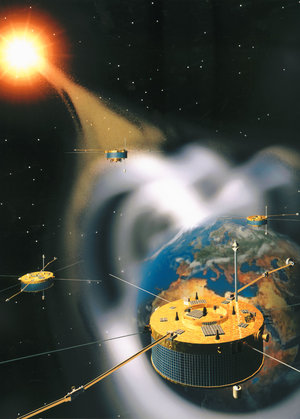
Giant electrical circuits power the magical open-air light show of the auroras, forming arcs in high-latitude regions like Scandinavia. New results obtained thanks to ESA's Cluster satellites provide a new insight into the source of the difference between the two types of electrical circuits currently known to be associated to the auroral arcs.
The deep mechanisms that rule the creation of the beautiful auroras, or polar lights, have been the subject of studies that are keeping solar and plasma scientists busy since years. While early rockets and ground-observations have already provided a few important clues for the understanding of these phenomena, the real break-throughs in our knowledge have started with dedicated auroral satellites, such as S3-3, Dynamics Explorer, Viking, Freja and FAST, and have now come to full fruition with ESA's multi-point mission Cluster.

The basic process generating auroras is similar to what happens in an old TV tube. In the TV tube, accelerated electrons hit the screen and make its phosphore glow; electrons in the atmosphere get accelerated in an 'acceleration region' situated between about 5000 and 8000 kilometres altitude, and rush down to the Earth's ionosphere – a region of the upper atmosphere. Here, they crash into ionospheric atoms and molecules, transfer to them some of their energy and so cause them to glow, creating aurorae.
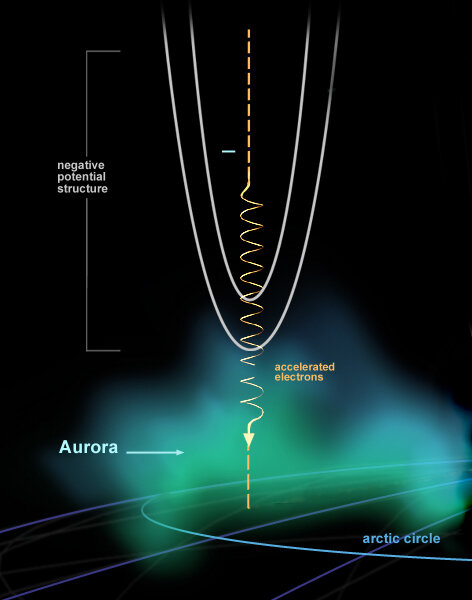
It is today well established that almost-static electric fields, parallel to the Earth's magnetic fields, play an important role in the acceleration of the electrons that cause the auroras to shine. The auroral electric circuits in the near-Earth space involve almost-static 'electric potential' structures through which electrons and ions are accelerated in opposite directions - towards and away from Earth's atmosphere -at high latitudes.
It had been observed that these electric potential structures are mainly of two types - symmetric (U-shaped) or asymmetric (S-shaped). In 2004, Prof. Göran Marklund from the Alfvén Laboratory, at the Royal Institute of Technology, Stockholm (Sweden), noted that the U-shaped and the S-shaped structures typically occurred at the boundaries between magnetospheric regions with different properties.
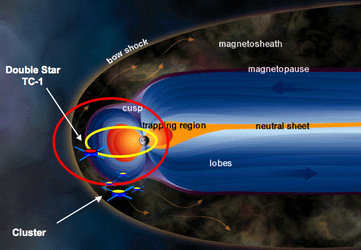
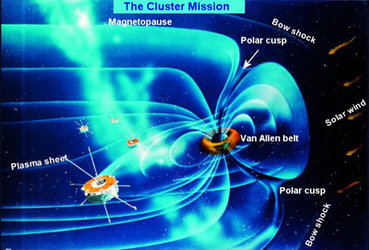
The former type (U-shaped) was found at a plasma boundary between the so-called ‘central plasma sheet’, situated in the magnetotail at equatorial latitudes, and the ‘plasma sheet boundary layer’, an adjacent area located at higher latitudes. The latter type (S-shaped) was found at the boundary between the ‘plasma sheet boundary layer’ and the polar cap, further up in latitude.
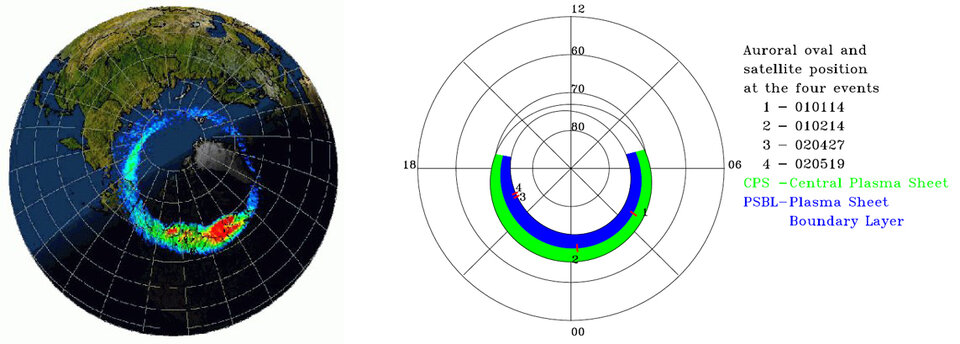
Marklund was then in the condition to propose a model to explain this difference. The model suggested that both the asymmetric and symmetric shape of the potential structures, observed at the different plasma boundaries, depended on the specific conditions of the plasma (such as differences in plasma density) in the two regions surrounding the boundary. According to the 2001 observations, he concluded that the plasma conditions at the lower-latitude boundary (where U-shaped structures were observed) are in general more symmetric, while the ones at the polar cap boundary (where the S-shaped structures were observed) are more asymmetric.
However, new Cluster measurements did not seem to be consistent with this picture. On 1 May 2003, one of the Cluster spacecraft crossed the auroral arc at high altitude in the Earth’s magnetotail. As expected, it detected the presence of a U-shaped, symmetric potential structure when crossing the boundary between the 'central plasma sheet' and the 'plasma sheet boundary layer'. Only 16 minutes later a second Cluster spacecraft, moving roughly along the same orbit and crossing the same boundary, detected an asymmetric, S-shaped potential structure, 'typical' of the polar cap boundary and therefore unexpected in that region.
However, within the 16-minute time frame between the crossing of the two spacecraft, the plasma density and the associated currents and fluxes of particles decreased significantly in the plasma sheet boundary layer. In this way this boundary ended up in resmbling the asymmetric conditions typical of the polar cap boundary.
So, the scientists interpreted that the 'reconfiguration' from a U-shaped to a S-shaped potential structure, and of the associated electric circuits that sustain the auroral arcs, reveal the change in the plasma conditions on the two sides of the boundary.
The results represent a major step forward in understanding the auroral electrical circuits, but important questions still remain open, such as: how do the process that accelerate the electrons to form auroras get triggered and maintained? Cluster measurements in the 'acceleration' area to be performed in 2008 and 2009 should help us to find out.
Note for editors
The results, by Marklund et al., were published in the 13 January 2007 issue of the Journal of Geophysical Research.
For more information
Göran Marklund, Royal Institute of Technology, Stockholm, Sweden
Email: goran.marklund @ ee.kth.se
Philippe Escoubet, ESA Cluster Project Scientist
Email: philippe.escoubet @ esa.int