Integral expands our view of the gamma-ray sky
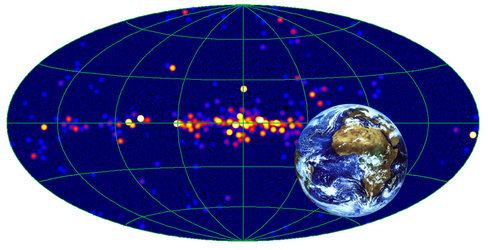
Integral's latest survey of the gamma-ray universe continues to change the way astronomers think of the high-energy cosmos. With over seventy percent of the sky now observed by Integral, astronomers have been able to construct the largest catalogue yet of individual gamma-ray-emitting celestial objects. And there is no end in sight for the discoveries.
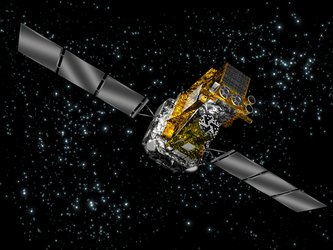
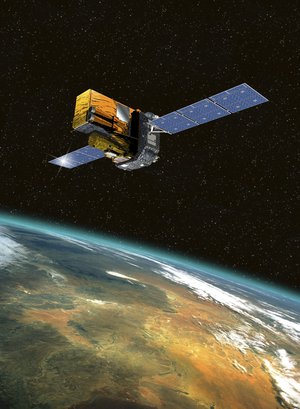
Integral is the European Space Agency's latest orbiting gamma-ray observatory. Ever since Integral began scientific operations in 2003, the project team has been devoting a substantial proportion of its observing time to a survey of the gamma-ray universe.
"The gamma-ray sky is notoriously variable and extremely unpredictable," says Anthony Dean, University of Southampton, UK, one of the original proposers of the Integral mission. Hence, the need for Integral's constant vigilance and an accurate catalogue of all gamma-ray sources. With this, astronomers can target individual gamma-ray objects for more detailed, study.

For the past three and a half years, Integral has been collecting survey data. At the end of every year, the data has been turned into a catalogue of sources.
During the first year, it concentrated on the regions close to the centre of our galaxy and found more than 120 sources. During the following year, Integral broadened its reach and found almost 100 more sources.
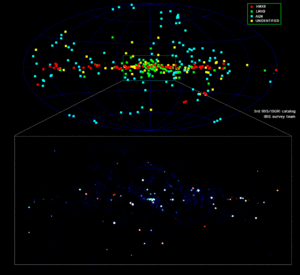
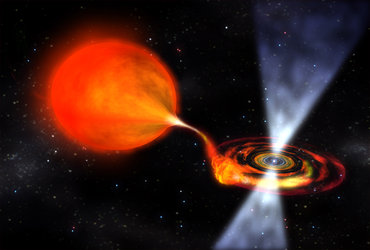
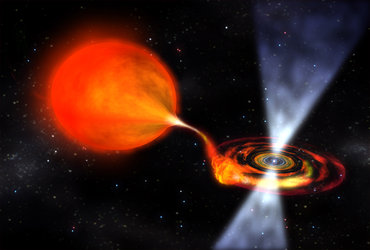
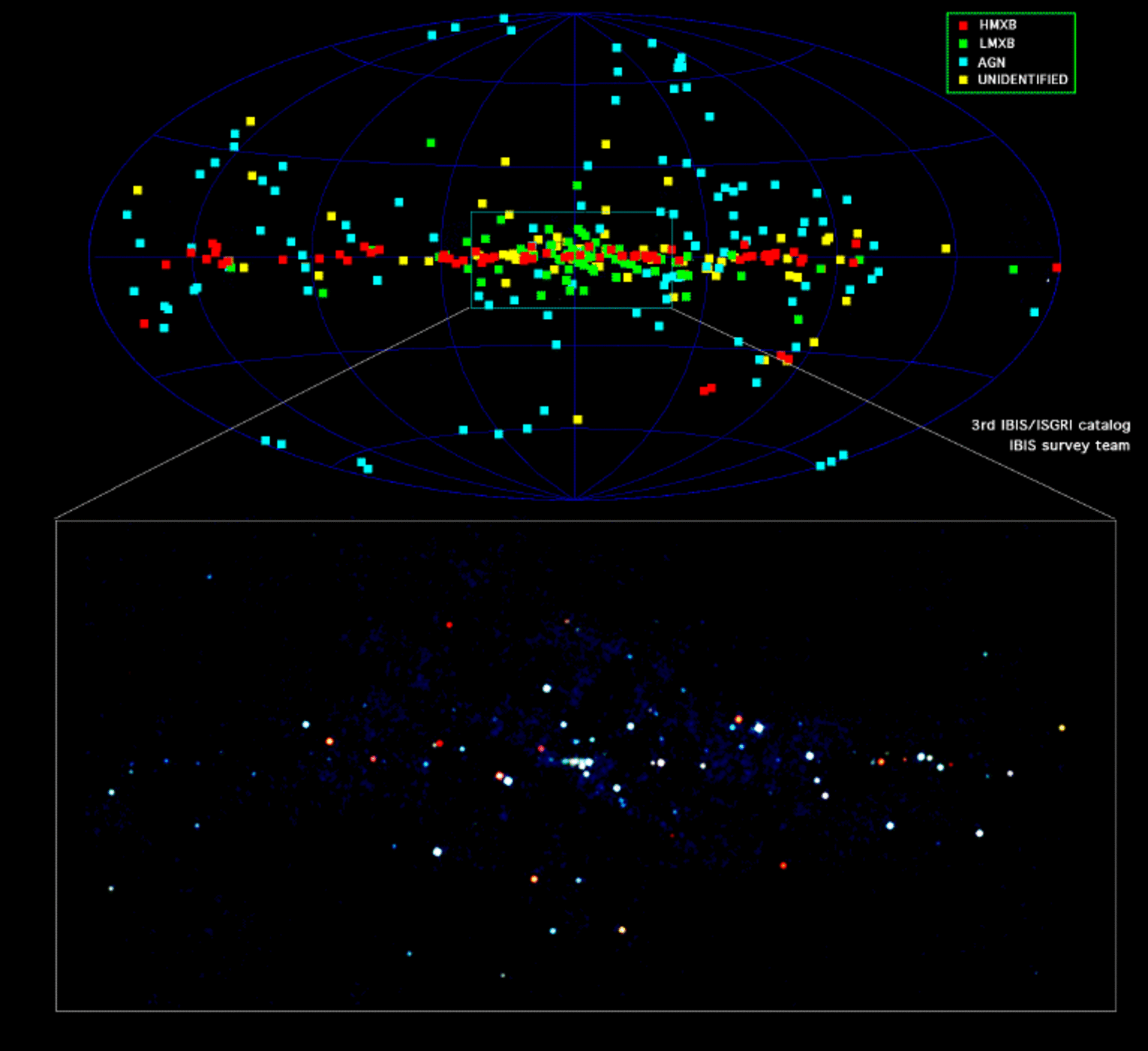
Now Integral has observed over 70 percent of the sky, with a total exposure time of 40 million seconds. A European team of astronomers led by Antony Bird, University of Southampton, UK, have turned all three years' worth of data into the third Integral catalogue of gamma-ray sources. It contains a total of 421 gamma-ray objects. Most have been identified as either binary stars in our Galaxy containing exotic objects such as black holes and neutron stars, or active galaxies, far away in space. But a puzzling quarter of sources remain unidentified so far.
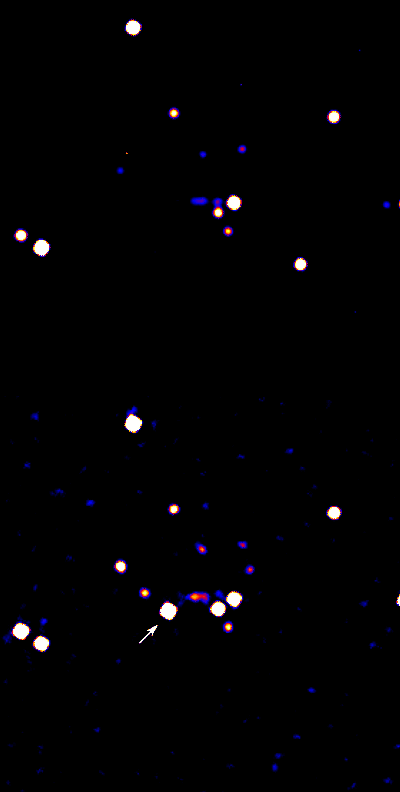
"I think many of these will turn out to be either star systems enshrouded in dust and gas, or cataclysmic variable stars," says Dean. Integral observes in the gamma-ray band so it can see through the intervening material. It has demonstrated that it can discover sources obscured at other wavelengths.
One surprise has been the efficiency with which Integral has detected just one minor subclass of cataclysmic variable stars (CVs), the so-called intermediate polars. Initially astronomers were not sure that CVs would emit gamma rays. Indeed, Integral has already shown that only about one percent of them do. "At the moment, the reason why this should be is totally mysterious," says Dean.
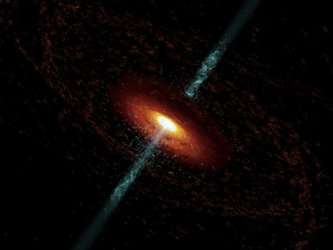
As its surveys points further from our Galaxy, so Integral increasingly sees the active galaxies. These represent about a tenth of all galaxies and each one has some kind of extraordinary activity taking place in its core. It is widely accepted that this activity is driven by a gigantic black hole sucking matter out of existence.
Roman Krivonos, Max-Planck-Institute für Astrophysik, Germany, and colleagues have used the Integral survey to show that AGN are concentrated in the same places that ordinary galaxies are found. Whilst this is not an unexpected result, it is the first time such an AGN distribution has been seen at high-energies.
"Integral represents a milestone in gamma-ray astronomy," says Dean. Thirty years ago, NASA’s Einstein observatory produced a catalogue of X-ray sources that became the standard reference document for all X-ray observatories – including ESA's XMM-Newton. "Integral is doing the same for gamma-ray astronomy," says Dean.
"We are in a golden age of gamma-ray astronomy," agrees Bird. And ESA's Integral is at the forefront of this brave new universe.
For more information
Antony Bird, School of Physics and Astronomy, University of Southampton, UK
Email: ajb @ phys.soton.ac.uk
Anthony J.Dean, School of Physics and Astronomy, University of Southampton, UK
Email: ajd @ astro.soton.ac.uk
Christoph Winkler, ESA Integral Project Scientist
Email: christoph.winkler @ esa.int