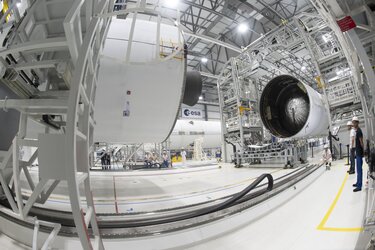
Ariane 6 – made in the Netherlands

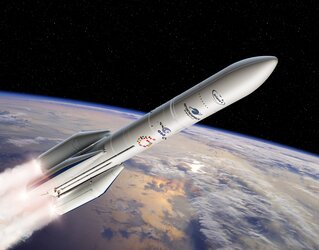
The Netherlands is home to the European Space Agency’s technical heart and largest site, ESTEC. Most satellites and space hardware pass through the test centre at ESTEC to get approved for space, including the upper stage of Europe’s largest rocket Ariane 6.
The Netherlands contributed 1.6% towards the Ariane 6 development programme to its inaugural flight, and so also builds and delivers components for the heavy-lift launcher: the Dutch branch of Airbus builds the frames that hold the Vulcain and Vinci engines in place while APP provides the flames that set the engines off at liftoff.
This series of articles is looking at the parts and components needed to assemble the Ariane 6 rocket – supplied by companies from the 13 ESA Member States participating to the Ariane 6 programme. Together they contribute the best of their know-how to build Europe's heavy-lift launcher under the guidance of main contractor ArianeGroup who also designed the Ariane 6 rocket.
Solid thrust

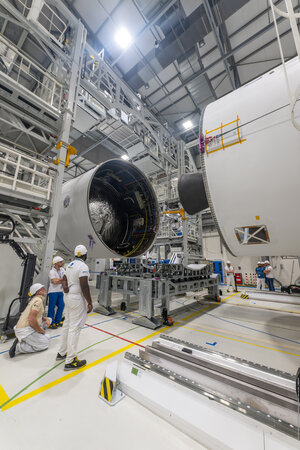
Not far from ESA’s technical heart ESTEC is the Dutch Airbus factory where the thrust frames for Europe’s new rocket are produced. These aluminium structures serve the sole purpose of securing the rocket engines in place – relative to the rest of the Ariane 6 – evenly distributing the thrust across the rocket's structure and efficiently transferring it to the core stage. This ensures the rocket accelerates in the correct direction, as it propels into space far beyond the speed of sound.
Airbus Netherlands supplies two thrust frames for each Ariane 6, one for the main Vulcain engine, and one for the upper stage Vinci engine. Airbus in the Netherlands is no stranger to developing thrust frames, as they were the prime company supplying the frames on the Ariane 5 series of rockets.

The two thrust frames are designed and built to ensure they are lightweight and can accommodate the myriad of fuel lines, electric wires and cables that need to pass through the frame and reach the engine for control and fuel supply.
While the Ariane 6 engines generate immense thrust, Airbus’s state-of-the-art construction assembly requires only 16 bolts to secure Vulcain 2.1 to its thrust frame – which is assembled with a drilling and riveting robot.

Thanks to integrally-milled structural components, the upper stage thrust frame is made up of just 11 parts – compared to over 1000 parts in the Ariane 5 structure – this leap ahead comes thanks to advanced manufacturing techniques. The newer models are lighter and require less manual effort to manufacture and are more cost-effective due to their innovative design and ‘Industry 4.0’ production process.

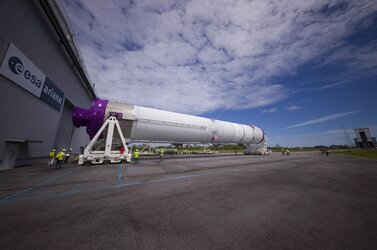
The frames take about a year to produce from start to finish, spending between three to nine months in the factory near Leiden. The upper stage thrust frame weighs just 330 kg and is shipped to Bremen, Germany, for integration with the Vinci engine and upper stage. The main stage thrust frame, weighs 4690 kg and is 5.1 m tall and 5.4 m in diameter. It leaves the Airbus factory for Les Mureaux, France, by boat because of its size. There it is connected to the Vulcain 2.1 engine and the Main stage.
It all starts with ignition

In the village of Klundert at the end of the river Maas, around 40 people work at Aerospace Propulsion Products, APP, now part of ArianeGroup. These people specialise in rocket engine ignitions. It’s a niche market, as they have one job to do: provide the flame to get a rocket reaction going. A hugely important component though: if they don’t ignite the whole launch countdown would be rather uneventful, ending on a whimper instead of a roar.
Flying a rocket is literally rocket science, but just starting a rocket is a complex feat in itself. For the Ariane 6 core stage it is a two-step process. First the gas-generator needs to be started, where APP’s starter provides hot gas to kick-start the turbo-pump. In parallel, an APP igniter provides a flame that starts the combustion in the gas-generator, after which the turbo-pump starts pushing the propellant to the main engine’s combustion chamber.

The igniters and starters that APP builds for the main Vulcain 2.1 engine are pretty much miniature solid-rocket motors in themselves – but shoebox-sized instead of meters tall. Like the large Ariane 6 boosters, the igniters and starters are filled with a solid fuel in a star-like shape and a small spark ignites the solid fuel, creating a powerful flame.
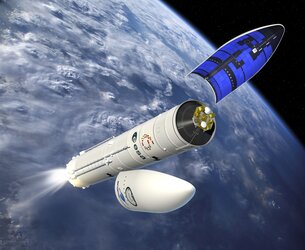
The igniters on the upper stage Vinci engine are not of the explosive kind, instead APP designed an ignition system that uses glow plugs similar to start a diesel engine. These plugs ignite a mixture of oxygen and hydrogen gas to create a very powerful flame. This is because the Vinci engine is restartable and the APP system needs to be able to start Vinci up to four times on each flight.
As with the thrust frames these two elements developed in The Netherlands are shipped to France and Germany for assembly with their engines. For the employees at APP the countdown to an Ariane 6 launch is even more exciting, as some of their components fire before liftoff and even engine ignition.