Ariane 6 – made in Romania

Romania has a long and rich history in aeronautics, including in rocket design. Romanian inventor Traian Vuiabuilt and flew the first motorised single-wing aircraft in 1906. The first Romanian to orbit Earth was Dumitru Prunariu in 1981 and Romania joined the European Space Agency thirty years later in 2011. The country’s first satellite was launched on the first ever Vega rocket flight in 2012.
As participating state Romania contributed 0.3% to the Ariane 6 development programme up to the inaugural flight. No company from Romania supplies an end product used on Ariane 6, but many companies contribute elements as subcontractors, providing the solid base to make Ariane 6 soar, reliably.
Over 600 suppliers provide the parts to build Europe’s largest rocket Ariane 6. Representing the best of European industry in terms of innovation and quality control this series of articles will be looking at the components of Ariane 6 supplied by the 13 participating states to the programme.
Limited angle motors for the high-thrust Vulcain 2.1

ICPE Electric motors provides small torque motors that help move Ariane 6’s main Vulcain 2.1 engine, direct its thrust, and keep Ariane 6 pointing in the right direction as it heads to the skies. Called the Low Liquid Thrust Vector Actuation System, the system uses hydraulics controlled by direct-drive electric valves to regulate the flow of the liquid which then moves the much larger Vulcain 2.1.
The motors are of the limited angle torque type, by reducing their scope of movement they offer high precision, are very fast and take up little space. The motor is similar to a drill that uses magnets and wound cooper but a limited angle torque motor rotates back and forth in less than 180 degrees. In this case the ICPE Electric motors device allows the flow of hydraulic fluid, that pushes the Ariane 6’s main engine. ICPE Electric motors ship their ware to Sabca for integration into the full control system.
Sonovision Romania: connecting the rocket

Sonovision Romania provided essential elements of the Ariane 6 electrical harness - the network of ground-test cables that ensures every subsystem of the rocket is verified, qualified and ready for launch.
These custom-built, long and complex test cables form the backbone of the ground verification process, enabling engineers to simulate flight conditions, validate electrical continuity and ensure perfect communication between rocket components.
Through precision manufacturing and meticulous quality control, Sonovision Romania helps secure the reliability of Europe’s newest heavy-lift launcher even before it leaves the ground.
Sonaca – covering aerodynamics

Located in Cluj, Sonaca Romania employs 210 people in the aerospace sector. The company plays a key role in supplying parts for major aircraft manufacturers and contributes to the Ariane 6 programme. For this rocket, Sonaca Romania produces two main types of components.
The first are composite covers that serve as protective caps for sensors on the rocket. Around thirty carbon-fibre parts are manufactured at their Romanian facility.
The second type is the BACO L-Square and Upper Cover assemblies. These assemblies include aluminium components that are stretched and machined in Belgium at Sonaca’s headquarters before being assembled in Romania. These structural rings are positioned in the lower section of the boosters and are essential to maintaining the rocket’s integrity during launch.
Together, these components enhance the Ariane 6's aerodynamics and structural performance, showcasing Sonaca’s expertise in advanced aerospace solutions.
TTTech: ticking like clockwork

The network chips for Ariane 6 are supplied by Austrian firm TTTech. Its development also takes place in Romania’s capital Bucharest where TTTech Development Romania is specialised in chip development, validation and verification. For Ariane 6 it was involved in the chip firmware and supported validation and verification.
Emsil Techtrans: heavy load – high precision

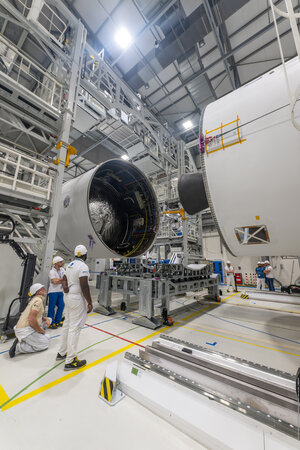
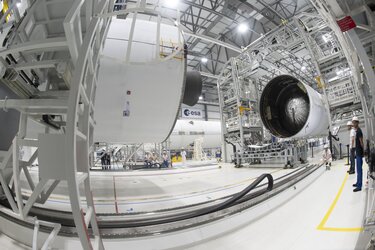
On ground Emsil Techtrans is a family business that worked on the alignment platform for the booster finishing facility, known as the EFF-dock. This dock is used for lifting and orienting operations on the Ariane 6 boosters and is part of the ESR Finishing Facility building (EFF) in Kourou, French Guyana.
The docking of the boosters is a challenge as they weigh over 150 tonnes and are filled with explosive solid propellant but need to be manoeuvred precisely onto the Ariane 6 on the launch pad. Emsil Techtrans Srl manufactured, assembled and passed the final acceptance test for its EFF-Dock which is part of the Ariane 6 Mechanical Ground Support Equipment (MGSE).
Gonzales Mecanica de Precizie: mobile precision docking

This twenty-year-old company specialises in precise mechanics, as the name implies. For Ariane 6 they made the mobile platform used to work on the fairing after encapsulation. If any people are lucky enough to be allowed to sign the Ariane 6 fairing, they stand on this company’s mobile dock.
Aerostar: a star in aeronautics
Romanian company Aerostar has been operational since 1953 providing components, maintenance and ground support in the aeronautical sector. Aerostar provided parts and assemblies for the engine thrust frames for Ariane 5 during its decade-long operations.
Now Aerostar supplies components for all three stages of the Ariane 6 rocket, delivering them to prime contractor ArianeGroup for further integration, building up the rocket.